
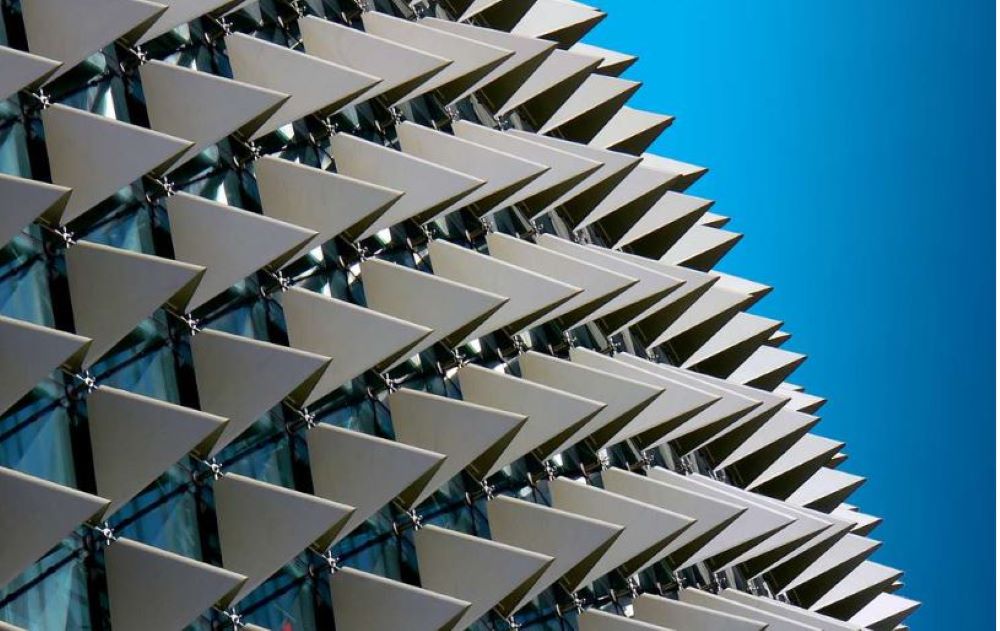
Editor’s Notes: The following notes on Singapore may help orient the reader in this story: Johor Bahru is the capital city of the Malaysian state of Johor. It borders the city state of Singapore to which it is connected by a causeway. Commerce between the two cities via the causeway is very important. Singapore has a rather formal civic culture and the distribution of chewing gum is restricted. The Esplanade, located on the waterfront, is the primary performing arts center of Singapore. A detail of that building complex illustrates this story. This is the second story Litbreak has featured taking place in Singapore. The first was Articuno Lampansé, published in 2016.
***
The day he got his braces was a good one. It was Friday evening, and his mother had picked him up from school after Chinese Orchestra practice. Instead of heading home, she drove them to Bedok, where the dental clinic was located, five minutes away from his primary school. During their last visit, his dentist had warned him of possible discomfort after getting his braces fixed and recommended him to consume soft foods in the initial period to minimise the pain from chewing. To make up for his restricted diet in the days to follow, his mother suggested going to the nearby hawker centre for his favourite chicken rice.
He hummed to himself as he followed half a step behind his mother. It had been some time since they last patronised the chicken rice stall, for he had started secondary school several months ago, and it was no longer as convenient to come by. Amid the crowd, his mother spotted an unoccupied table. She hastened towards it. But it was yet to be cleared; on it a red plate with remnants of rojak. She pushed it to the side and gestured for him to sit. Taking care to leave a considerable distance between the plate and himself, he did as he was told. Even from a distance, he could hear his mother place their usual orders in Mandarin, “White chicken breast,
remove skin, remove bones. Two plates, thanks!”, before returning to his side.
It was a humid day, and the thin fabric of his uniform pasted itself to his back. Still, when the drinks vendor came by his mother ordered her usual teh c siu dai. Seeing as she was in a good mood, he asked for a Kickapoo. Their beverages arrived soon after the red plate of rojak had been cleared away. He waited as his mother wiped the top of the can with a tissue before pulling the ring tab. It opened with a pop and a delicious hiss. Eagerly, he poured the golden liquid into a cup filled with ice cubes that had already begun to melt. While his mother stirred her steaming tea with a bent metal spoon, he took a deep draught of his citrusy, fizzy drink.
He closed his eyes for a few moments, savouring the sweetness of coolness flowing down his throat before he began to tell her about his day. He recounted how the Appreciation of Chinese Culture period had gone by in a blur. The teacher went on an unceasing monologue for the whole period, inundating the whiteboard with illegible Chinese characters, oblivious to the murmuring of students behind her. But literature was interesting, he continued. They discussed a new chapter of the book they were reading, Sing to the Dawn, in which the protagonist was facing a thorny conundrum with her father. As for maths, the new concepts on algebraic expressions were tricky, but his weekly tuition classes with Mr Tan helped him to grasp them quickly enough. He added the last part to reassure his mother, who, as he had hoped, nodded and smiled approvingly at him.
A woman with a shock of white hair arrived with their food. He wasted no time in drenching his serving with syrupy sauce. As he spooned generous amounts of fragrant rice and chicken into his mouth, his mother drizzled chilli sauce over her helping. She took a few sips from the accompanying bowl of clear soup before she finally asked, “And how was CO practice?”
He had been waiting for this moment all afternoon. With his mouth half-full, the words burst forth from him: he had been chosen to be the soloist for the annual concert at the Esplanade next year. His mother’s eyes lit up. She exclaimed in pride. She dropped her spoon and pulled him tightly to her chest, impervious to the greasy grains of rice around his mouth and the steady stream of perspiration running down his back.
Later, passing by the ice-cream uncle with his pushcart as they walked to the dental clinic, his mother decided that he deserved a cool treat. They had fifteen minutes to spare before his appointment. He picked the raspberry ripple flavour and watched the elderly vendor slice off a marbled slab from a large cream block streaked with red, before sandwiching it between crisp wafers for him.
***
To describe the first days after he got his braces as dreadful was a gross understatement. The discomfort his dentist had cautioned him of turned out to be excruciating pain. He was constantly famished, but the bland, watery congee and foul-smelling soups prepared by his mother made him lose his appetite. He stopped talking to her, citing pain as pretext. Instead of spending time with his parents in the living room as he usually did, he retreated to his room, brooding.
The hours of unmet cravings filled him with hunger and bitterness. A bitterness arising from his having been so easily persuaded by his mother to get braces. He hadn’t even wanted them in the first place. She was the one who claimed that the children of several of her friends had gotten them when they were around his age and kept harping on about how useful braces were in aligning their teeth and correcting their overbites. According to her, braces were very expensive, but his parents saw it as a worthy investment for him—one he would be sure to thank them for when he was older. Imagine the dazzling, straight teeth you’ll have when it’s all done, his mother had coaxed, flashing him a mouth overcrowded with crooked teeth.
On Sunday evening, he trudged to the toilet and locked the door behind him. Slouching before the mirror after brushing his teeth, he bared his teeth once more in the glass. Fine, they were not perfectly straight. Some were misaligned. The most prominent of them were his two front teeth, which jutted out as a result of his bad habit of gnawing at chopsticks when he was younger. They had caused him to be the target of taunts back in primary school. “Bugs Bunny is here!” his classmates used to make fun of him. But he hadn’t been overly concerned about them. Being able to immerse himself in his books and music made him happy. Everything else was secondary.
He gargled the medicinal mouthwash, spit it out, then wrapped his lips over his armoured teeth. Everything will get better soon; he told his reflection. Without warning, the image of crispy chicken wings glistened in his mind, and for a moment, he felt a smile tug at the sides of his lips.
***
When he returned to school on Monday, he discovered that his new orthodontic enhancement device held more far-reaching effects than he had initially anticipated. He could have ignored the persistent rumbling of his stomach, especially during recess. He could have ignored the pointed glances from his classmates whenever he opened his mouth to speak. But there was something he couldn’t ignore: his best friend’s reaction when he had to decline his offer of fruit gum.
He had gone to Han Ming’s place after school, and they had just finished their homework when his friend tossed him a small, square box with a single strawberry printed on it. It was something they always enjoyed—blowing bubbles with the small, sugary balls of gum procured by Han Ming’s grandmother from across the border in Johor Bahru. There were four flavours in the pack—melon, strawberry, grape and orange—and strawberry was his favourite. That chewing gum was banned in Singapore made the shared experience more gratifying, deliciously clandestine. An experience he could no longer partake in, at least not for a while.
His gaze remained fixed on the pale pink bubble ballooning out from Han Ming’s lips. He couldn’t recall the last time he had blown one so large, so beau—before he could finish the thought, his friend popped the bubble. In its place came a retort, “What’s the point of fixing your teeth if you can’t even enjoy the good things?”
***
The full weight of it landed on him on Wednesday afternoon, in a lecture theatre packed with uniform-clad students. Orchestral practice was about to begin, and he was sitting with his wind section mates in the last, topmost row. He played the suona, a double-reed woodwind instrument known for its loud, strident tone. When his classmates first found out about it, they had laughed at him, gesticulating wildly with their arms to mimic the trunk of an elephant. Commonly associated with the shrill sounds it blasted at traditional Chinese weddings and funeral processions, the trumpet-like instrument hadn’t been his first choice.
He glanced to the bottom right of the lecture theatre, where those from the strings section sat with their delicate instruments perched on their laps, chatting gaily among themselves. Of all the instruments played in the Chinese Orchestra, that was the one he liked the most. The erhu—a bowed, two-stringed vertical fiddle whose strings reverberated with a sweet, sonorous beauty capable of reaching his core—an instrument which reminded him of the violin. But the choice wasn’t his to make, for his seniors had decided, at first glance, that his heavily-built frame would make for a competent suona player.
The double doors on the left flung open just then, and in strode the Conductor. The lecture theatre, which had moments before been brimming with activity, fell still. The Conductor was a man of short stature and rare smiles, but whatever he might lack in height and affability, he more than made up for it in his demeanour and presence. When it came to music and discipline, he was known to be exacting to the point of being unsparing, a trait which commanded respect and fear in equal measure. The Conductor now took his place at the front of the lecture theatre, where the top of his head gleamed under the florescent light. Unlike other men his age who tried with limited degrees of success to conceal the spot with long, sparse strands of grey from the sides of their heads, the Conductor somehow managed to carry his receding hairline with an air of dignity.
From his vantage point, he could see everyone straightening in their seats. He stiffened his back. The Conductor announced the piece with which he would like to begin. A shuffle of papers, a murmur of voices, the accidental pulling of strings. Within moments, everyone had the correct score on their music stands. All eyes were now on the Conductor, who had his own closed. He lifted his baton. Right on cue, his senior who played the zhongyin sheng blew the tuning note for the orchestra: A.
It didn’t take long before the cellos began to sing. Their deep, soulful voices faithfully followed the rise and fall of the Conductor’s baton, which seemed to have come alive in his fingers. Watching the cellists draw straight, smooth bows on their instruments, he suddenly felt an intense desire to play his violin. He might have had one in his hands now, had he been allowed to choose the String Ensemble as his ECA—no, CCA, he corrected himself. He often had to remind himself that Extra-Curricular Activities had become Co-Curricular Activities. On CCA Orientation Day, he had been drawn to the String Ensemble and the English Literary Club. But his mother was of a different opinion. According to her, his secondary school was known for its Chinese Orchestra, which had never failed to clinch the gold at the biennial Singapore Youth Festival competitions. If he were to join the acclaimed orchestra, it would increase his prospects of securing a place at the best junior college four years later. Naturally, he deferred to her.
A nudge from his senior Wei Yue yanked him out of his thoughts. He looked up and realised that the dizis in front of them were now moving in harmony. Their part was coming in four bars. Tapping the beat with his right foot, he lifted the suona to his lips and moistened the reed. The white baton swung in the air, charged with an electricity that seemed to emanate directly from the Conductor’s being. He watched as the Conductor’s shoulders soared higher, as his brows furrowed deeper. He felt the surge of music, the swell of emotion. With his fingers in position and eyes on the baton, he drew in a deep breath and joined the rest of the orchestra when the cue came.
But barely three bars in, the baton froze. He winced. He felt the eyes of his seniors on him. He held his breath, humiliation filling his lungs. He had been warned about the potential pain from having braces, about its effect on his food consumption and appearance. But what he hadn’t known, much less imagined, was the impact on his capacity to play the suona. His mouth, like his face, was burning. He hadn’t expected that the tiny metal brackets on his teeth would so drastically affect the way his mouth wrapped around the reed of his instrument. Those few notes that used to be effortless for him to play now required a shocking surfeit of effort. Even so, they had come out excruciatingly flat, horrendously out of tune. With quivering hands, he put down his instrument.
Again, the Conductor demanded.
The sight of those pressed lips and the impatience brimming in the man’s shoulders caused him to shudder. Not daring to meet the Conductor’s eyes, he focused on the tip of the white baton, suspended in mid-air. Tentatively, he lifted the suona to his lips.
This time, when their turn came, he inhaled and exhaled only through his nose. His fingers moved with practiced ease over the eight sound holes in the rosewood. His eyes ran across the page, across the assortment of numbers on the score—some dotted, others underlined—a once unfamiliar musical notation that he could now decipher with greater fluency than the western one with its firm staves. But these numbers couldn’t help him. He began swaying his upper body, raising the flared brass bell of his instrument to the melody—as if he were actually playing, as if the metal in his mouth had no effect on him.
When the suona section finally came to an end and the Conductor’s attention had turned to the pipas, he let out a shaky breath from his lips. He ignored Wei Yue’s stare. It was only the first practice session since he had gotten braces, he tried to reassure himself. Things would surely improve in a week or two. He should count himself lucky that the Conductor hadn’t chosen to go through the piece for which he was soloist.
He reached for his water bottle and took a gulp of water. Out of habit, he wiped his mouth on the sleeve of his uniform. For the first time, it left a smear of blood on his pristine white shirt.
***
As the weeks passed, he became increasingly desperate. His braces no longer restricted his diet as they had done before, and he could have consumed more fried chicken wings than he could have counted by now, given the rate at which his mother was piling food on his plate. But his lack of appetite persisted. When his height and weight were measured for the second time that year, his PE teacher praised him for having lost four kilogrammes.
Despite his mother’s concerns, he began to stay later and later at school—at first increasing the duration of each practice session, then their frequency. It humiliated him deeply that he had to practice the suona there, where all his orchestral mates could hear him. He would have preferred to suffer privately at home, but on the first afternoon he tried playing his scales in his room, the neighbours had come rapping on the front door. Unlike the strings of the violin, the blare of the suona was not, understandably, pleasing to their ears.
Before long, he was spending every afternoon after school practising the suona. His violin and books lay forgotten in his room. Each time Han Ming asked if he would like to go over to his place, the Conductor’s voice would resound in his head: 台上一分钟,台下十年功—a minute on stage requires a decade of practice offstage.
He was no stranger to hard work and long hours of practice. How else could he have passed his Grade 8 Violin Exam with Distinction just the year before? This time, he recognised that things were different. The more he practised, the worse he became. The sharp pieces of steel scraped his gums each time he tried to finish a song, causing them to smart and bleed. The brownish red stain remained on the sleeve of his otherwise white shirt—faint yet indelible. Despite his distress, he swallowed his confusion and withheld everything from both his mother and Han Ming.
He might also have attempted to hide his deteriorating state of play from the rest of the orchestra. Perhaps he might even have been successful, had he played a different, quieter instrument. Like the pipa, or the erhu. One that didn’t demand attention to be drawn to itself. But he played the suona, as a soloist. Everyone noticed.
At first, they tried to be encouraging. Not only his peers, but also his seniors, his section leader, his teachers. After all, they had seen something in him, something special enough to have chosen him to play the solo for their forthcoming concert—a privilege that had never before been accorded to a junior like himself. But he soon realised that patience was a virtue that came with an expiry date. Within weeks, the pep talks gave way to lectures, and on one Wednesday evening, unequivocal reproach.
Gripped by the fear of letting everyone down, he pushed himself harder than ever before.
***
Things came to a head two months later, when the Conductor requested to speak to him.
On Friday afternoon, an hour before the biweekly orchestral practice was scheduled to take place, he followed the covered drains leading to the Conductor’s office. It was his first time inside, but instead of glancing around the room, he quickly bowed and kept his head down. If the Conductor, seated behind his large imposing desk, had noticed his hands shaking, he made no mention of it. He obeyed the Conductor’s command and sat himself down. His hands gripped his kneecaps, bracing himself for the news. He listened quietly, his lips pressed together, concealing the metal in his mouth. When everything that was to be said had been said, he bowed, thanked the man and left.
Instead of heading back to the canteen where Han Ming was waiting with his schoolbag, he turned and began walking in the opposite direction. It was not until he had made his way along the length of the parade square, down the line of classroom blocks and reached the large rock by the quiet pond at the end of the school compound that he allowed himself to exhale. Logically, he understood where the Conductor was coming from. It was the best choice for everyone, himself included.
Despite the blistering heat, a chill spread to his fingers. He crouched down by the rock and hugged his knees to his chest. The concert was coming up in ten weeks. Every member of the orchestra was practising as hard as they could, but they were not there yet. Far from it, he knew. He had listened to the recordings of the past decade of annual performances the orchestra had done. The problem lay with him: the supposed concert soloist. They had tried to be understanding but couldn’t afford to take the gamble much longer. There were musical standards to be upheld, concert programme booklets to be printed. The Conductor was now asking whose name was more deserving of being printed in the programme booklet as concert soloist—his or Wei Yue’s. It was a question he and his senior would be given two weeks to answer, by the end of which a review would be made and the decision, finalised.
The words of the Conductor began to slur, echoing in his head. His arms burned under the merciless sun. Leaning on the rock for support, he retched. A mixture of blood and vomit pooled at his feet, soiling his freshly starched shoes.
Moments later, he blacked out.
***
Years passed. His braces were eventually removed. He no longer remembered the words he had muttered under his breath when he finally came to in the hospital, seeing his parents by his side—his father, impassive, his mother, distraught. He no longer remembered the way in which he had vehemently stuffed bits of opaque wax over the metal brackets of his braces, attempting to stop them from cutting him, from cutting him off from his music. He no longer remembered the dizziness that had flooded his head, standing on stage before an expectant audience at the Esplanade Concert Hall one evening. Perhaps, he chose not to remember these things.
But there was one thing he could not forget.
Each time he looked into the mirror, the reflection of his dazzling, straight teeth induced a dull ache in his chest that would not abate.
*****
Born in Singapore and based in Germany, Agnes Chew is the author of The Desire for Elsewhere (Math Paper Press, 2016) and Eternal Summer of My Homeland (forthcoming from Epigram Books).