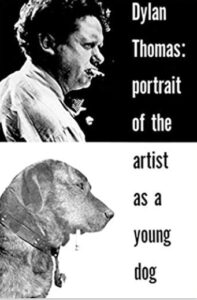
 Portrait of the Artist as a Young Dog by Dylan Thomas came to my attention yet again when Jean Seberg asks Jean-Paul Belmondo if he’s read it in Goddard’s iconic Breathless. I’ve always thought when Goddard mentions writers in his films, they are authors that he approves of. And I can see the class conscious Marxist loving Dylan’s book. As for Belmondo’s character, a small time hood and cop killer, it’s unlikely he would be reading literature. And I think the Seberg character, whose parents hope she’ll attend the Sorbonne, realizes that. I take it as a clear signal that their relationship as lovers will fail. Seberg is testing Belmondo and he is coming up short, only not in bed. That’s how I see it anyway, with the benefit of the hindsight of seeing the whole film.
The Portrait is a set of ten stories that dance as well as they walk, even though the characters within its pages can sometimes be seen to stumble. Meaning: the prose is on the threshold of the lyricism of poetry in almost every story. And it’s poetry that breaks the reader’s heart on account of its beauty as much as it seems to crack the heart of its author.
This breaking of its prose starts with a hint in the first story, “Peaches” with the bending of reality, or the interference with it, by the dark light of a child’s nightmares, which authentically, he is challenged to separate from his everyday life.
In “The Fight” a boy wonderfully says that he “can bleed anytime he wants”. A proud boy’s boast that expresses what boyhood is, it seems to me, better than any other one-liner I have heard.
In “Extraordinary Little Cough” we run into a priceless adolescent line when a boy observes that he has picked a girl for himself, although he likes nothing she says and nothing she does.
“Just Like Little Dogs” opens with “Standing alone under a railway arch out of the wind…” The story provided me with a key to the writer’s mind. Nothing in art is hidden, and nothing is revealed. In literature, it’s up to the reader to “liberate” the book, to render it living, as it has a potential for being. A young man under shelter of railroad bridge in wind, rain and surf. It’s a night vision. He loves wandering his Welsh town after midnight. Walking the nocturnally abandoned High Street. And under the arch he hears a faraway dog barking whose location he can’t quite identify. To me that bark seems like the dark soul of the town. He imagines people up on the hill in their comfortable houses, entertaining friends and family. A young man’s anthem to loneliness. But here’s where the animating tension is: Lonely as he is, I’m not sure he would want the company. He both wants the togetherness and feels an emotional distance from it. The narrative moves up a level when two others also seek the arch’s shelter, and their stories within the story illuminate the whole, or better, become the whole of what the story should be.
“Who Do You Wish Was With Us?” is a ritual of both friendship and mourning, containing also one of those oceanic surges of poetry, coming seemingly from nowhere but conveying the sense that it was there all the time. I sighed and teared up over this one. How eloquent an expression of life’s burdens and its lost beauty…but the beauty is real. It’s a Land’s End vision.
Dylan Thomas as a prose writer has a gift for portraying the full span of the community it seems he grew up in. In the final story, “One Warm Saturday” it is as if his whole town is on the page and at the beach. But like in that common sort of nightmare that we probably all have had, he no sooner finds them than he loses them. You’ve had that sad dream haven’t you? In that dreaming, you find that essential person, the almost mythic friend, only to turn your back for a second and lose them. You wake up.