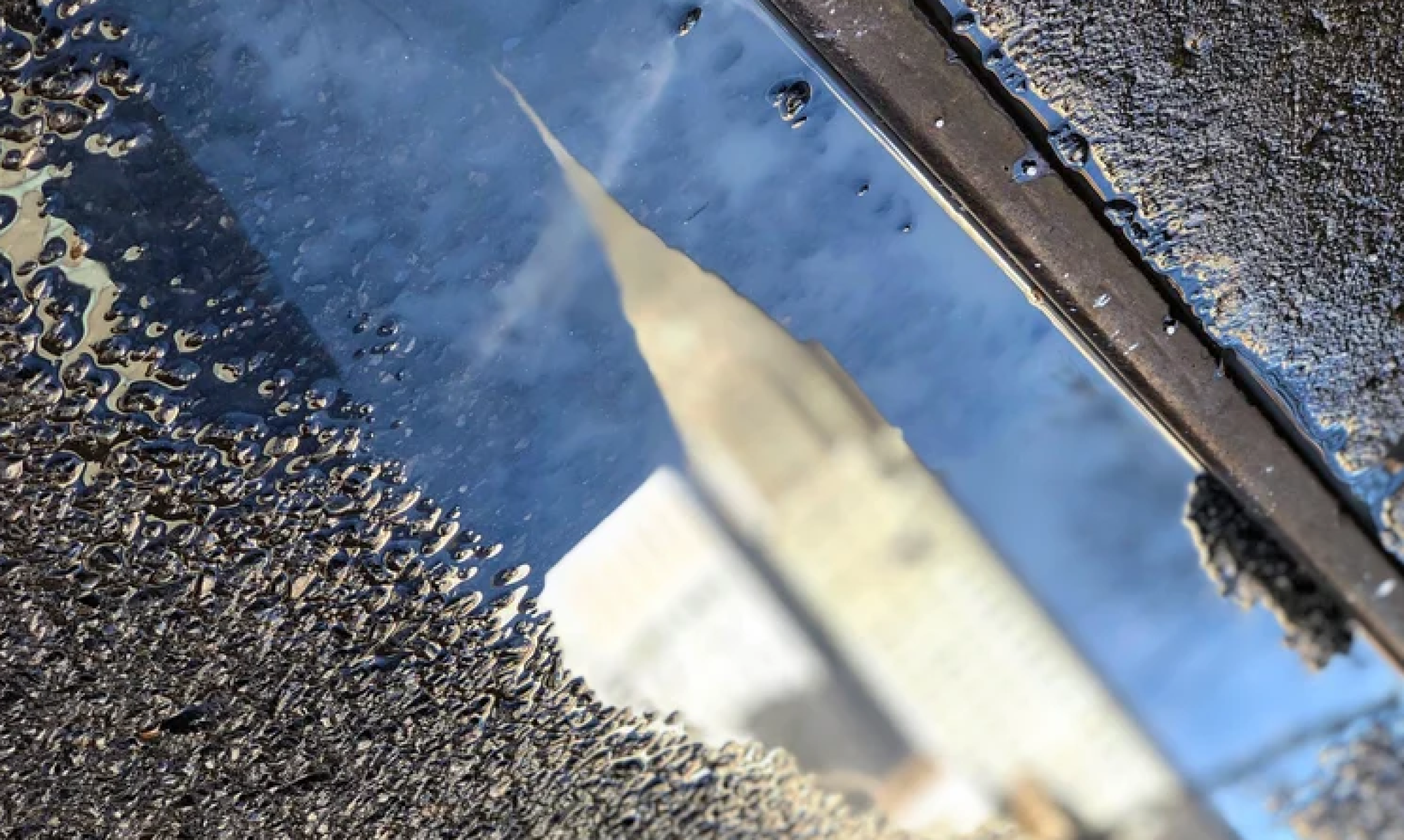
The sun coming up over the trees helped dispel the dream.
All I remembered now was looking down at my foot after it had been shot. The shot had gone straight down through the top right side of my right foot, going right through the bone and somehow snapping it cleanly in two. The front part of the bone, the part that still connected to my little toe, twisted sideways and tried to push out through the skin on the outside of my foot. It hurt but I could still walk, and so I did. There had been this pressing need to get somewhere, even with a fucking hole in my foot.
These dreams haunted me. Always trying to get somewhere. Never making it. Like being stuck in purgatory.
It’s still early morning, the grass is wet with dew, and the shadows are long with just a few patches of sunlight sneaking through. I settle down on the bench to watch people go by.
The dream fades in my head, and I start to feel more like myself. I’ve always enjoyed people watching. But not in the way most people do, talking about their clothes and how they look and why on Earth they decided to dress that way today. When I watch people, I imagine what they used to be like as kids.
I see an older woman with bark-colored skin and black-dyed hair coming down the path? She’s thin and has a slight hunch to her shoulders. Her morning walk around the lake is accompanied by a cigarette. I can see her as a child. Her hair poofed out in tight curls that never want to behave. Her eyes sparkling mischievously. I bet she used to like to play outside and never came home without being a mess. I can see her coming home to her parents one day with something in her hand. She’s trying to hold it gently, so she doesn’t squish it, but it keeps tickling her hand as it wiggles around. She’s going to surprise her older sister with it. Her older sister was the princess of the family, always dressed well and with boys already ogling her in high school. She’d walk right up to her sister and tell her she had a surprise and then let it jump out on her before she knew what was coming.
I smiled fondly, imagining her tormenting her sister. You’d never see that in her now, walking stoically down the path.
Now there is a man coming down the path. He is jogging, a light sweat on his exposed skin in the brisk morning. I wonder what he’d been like as a kid. He looked like a loner. I can see him in my mind. He struggles to listen to his parents. He’s probably the oldest so a lot of responsibility fell on his shoulders, but he was never that good at managing it. His younger brother was better at it, but no one put that kind of pressure on the second son. One day his mom asked him to watch the food on the stove because she had to go out for an appointment. He nodded absentmindedly while drawing. He completely forgot, lost in his own world. Soon his younger siblings came running in saying there was smoke in the kitchen. He froze trying to process the information. Smoke. Fire. Should they run out of the house? Then he remembered the food. He ran into the kitchen and turned everything off. His panicked mind thinks: I should hide the evidence, and he grabs the food and dumps the food into the sink. He shouldn’t have done that. Now what would they eat? His mom would kill him. What should he do? He put his hand on the hot stove to burn it, thinking that he could at least get some sympathy from her if his hand was hurt. It quickly blistered, and even after his mom came home it still burned. But it didn’t save him from the tongue lashing and spanking.
As I watched the jogger pass, I noticed that there was a scar on his hand where I had imagined him burning it. Some memories stick with you in more ways than others.
These were people’s memories that I saw. Some were pleasant. Others not so much. People carried a lot in them, stories you’d never even imagine were real or possible. My father used to sometimes tell stories back in the village. He’d always say a good storyteller renews the story with each telling, weaving in memories and personal experiences to subtly change it and make it a new story.
But these were actual memories that I saw. Sometimes they would get lost. At least, that’s what I called it. Somehow, they were separated from their owner. Maybe the owner just forgot the memory for so long it wandered off. Or maybe the owner wanted to forget the memory. Trauma was a bitch. I remember when I was little back in Lebanon how many traumatic memories would just be wandering around. I had no idea what to do with them. But they became part of the atmosphere, an ever-breathing collective trauma. Wherever I’d go I could sense the weight of years of war and violence twisting the air around me. Why couldn’t my uncles ever stop talking about the war? Because their memories were always running around them, like a nuthouse only visible to me. Their friend who got his hand blown off by a mine. The car bomb that went off by the mosque. Being held captive for months. Airstrikes. When they got together, one memory after another kept feeding off each other, until it was just a whirlwind of pain, a wound that never seemed to close.
That’s why I’d left. Most people thought I’d left for better job opportunities and money. But the truth was that the pain was too much for me. There was a lot I missed about Lebanon, but the pain was beyond my limits. It had been oppressive, raising me into a quiet and awkward teenager with no tools to deal with it.
My parents had helped. My mother always said I was sensitive to the world around me. She’d comfort me when things got overwhelming, sending everyone else out of the house and just spending time with me cooking and sewing. She loved sewing. As I watched her sew, I could see those memories bubble up in her. Sewing with her mother. Her first quilt. Pricking her finger and having her mother gently wipe away the blood and show her how to put pressure on the prick until it stopped.
My father would always be there for me, too. In the evenings when he could tell I was drowning in a pain he couldn’t understand, he’d sit with me and tell me a story, weaving in his own memories. Hasan al-Shatir was suddenly a young boy working in a village coffee shop, and the ghoul he challenged was a local bully who it turned out had no friends. When he caught his fish, it was near the island just off the coast where our family swam. He put his heart in his stories and that brought me comfort.
I got up to leave, noticing a kid crouched at the edge of the woods as I got up. I wonder where her parents are. I walked up to her, making sure not to get too close so as not to startle her. I called out to her, “Hi dear, are you okay? Where are your parents?” I assure her as well, adding, “Don’t worry, I won’t get closer than this. But if you want, I can call your parents on my phone and tell them where you are.” She doesn’t respond. I take a step closer, and suddenly she turns around. She’s holding something in her hand. She opens her hands and a frog jumps out on my face. I fall backward, swatting at the frog. But suddenly there is no frog, and I’m just sitting on the dewy grass. I look for the girl, but she’s nowhere to be found. A lost memory.
It was probably that woman’s memory that I had seen earlier. It was sometimes hard for me to tell the difference between the memories and reality. That hadn’t helped growing up. So many people had mocked me that I just decided it was better to not talk much and especially not to talk first. Best to let others confirm that what I had seen was reality before saying anything.
I wonder why this woman’s memory had gotten lost. It wasn’t an unpleasant memory. In fact, it seemed rather funny. Unless it had something negative associated with it that I hadn’t picked up. Or perhaps the woman just had forgotten it.
I spot the memory again. This time it is running around trying to catch a jumping bug. I approach slowly this time, enjoying watching the free spirit at play. Does a memory have memories, or is it just talking about itself? I’m suddenly curious. Can I talk to a memory? I’ve always felt safer just watching. I call out to the girl, asking her what she’s doing. Once, twice. Still no response. I try Arabic on a whim. It’s just a memory.
She surprises me by responding in Arabic, “Catching bugs.” Her language catches me off guard. We’d call it fallahy back home—a rural dialect of Arabic without the trappings of urban sophistication. It was my parents’ dialect, even though we moved to the city when I was young where my father opened a shop.
“What for?” I ask.
“I’m gonna scare my sister. That Hala, she always thinks that she’s the center of the world, acting like a princess and all. She doesn’t want to play with me anymore. All she does is talk about her friends at school and nag mom and dad to let her go out with them. Well, I’ll get her. I’ll catch a big bug, or if I’m really lucky a frog, and throw it on her. That’ll teach her.”
I laugh, telling her I think that is a splendid idea. Trying to figure out why she’s not going to back to her owner, I then ask her, “What do you think will happen when you throw the bug or frog on her?” The memory laughs.
“Oh she’ll scream bloody murder she will. Khayfaneh hiyye. She’s a scaredy cat. And I’ll have to run out of there lickity split before she catches me. If she gets me, she’ll give me a good whopping I’m sure. But if I can get out of there fast, she can’t do anything in front of mom and dad, or they’ll give her a whopping.”
But here the memory pauses. “What’s wrong?” I ask. The mood changed suddenly. The first part of the memory had a fun tone to it. Now there was something else. The memory was remembering itself.
“I scare my sister. I scare her good.” She’s talking in the present tense. Like it’s happening right now. “And I dash out of the room like a lightning bolt. Like a rocket I’m down the stairs. And I get outside and start dashing to my parents in the field. They’re supposed to be out plowing the field getting ready for the next season. Instead they are running toward the house, shouting for me and my sister. I can’t make out what they are saying so I keep running toward them. My father grabs me without stopping. His speed against my speed knocks the wind out of me. He carries me like I’m nothing even though he’s always teasing me that I’ve become so heavy these days and he can’t carry me anymore. But now he doesn’t even seem to notice my weight. He’s rushing to the storm shelter. And then I hear the siren. The planes are coming again. They’re coming to bomb us. Every time we heard the sirens, we were supposed to run for the shelter. Don’t wait, don’t think. Just run.
“My father throws open the door and puts me down, practically shoving me into the shelter, before going back to the house. Why isn’t he coming with us? A moment later I see my mother, but she stays on top shouting for my sister to come. Then I remember Jiddu. Jiddu was an old man and walked with a cane now. Baba had gone to get Jiddu. I see them coming, with Baba hurrying his father along as fast as he could. I see my sister rushing in.”
The memory stops talking. Was that the end of the memory? Was the memory scared of what happened next? I sit down next to her. She’s shaking, crying silently. Should I hold her? How does one comfort a memory? Nothing seems right as I sit silently in the dew.
“Sir, are you all right?” I turn around, startled out of my trance. It’s the woman whom I had seen earlier. The woman whose memory I had been talking to. Her skin has a glow in the morning light, and despite a few lines around her eyes she doesn’t seem as old as I first thought. As I look at her face, I can clearly see the little girl that she used to be, and for a moment I’m lost between the past and present. She must have made a loop around the lake and come back. I stand up, flustered and futilely trying to wipe my damp pants. “Are you okay?” She asks again.
“I was just… I thought I saw someone… There was a frog…” I start and stop, unsure how to explain why I was kneeling in the ground. She’s looking at me oddly. “Where are you from?” She asks in Arabic. I suddenly realize I had been talking in Arabic like I had with the little girl. “Lebanon,” I answer.
She smiles, saying, “I’m from Lebanon, too. From a small southern village.” She talks like that little girl, and her accent brings back so many memories.
There is an awkward silence as I fail to respond. Normally I’d fill the space with pleasantries—Arabic has thousands of them—but now my head was spinning with my memories and hers. So instead I ask her, “Do you live here now?”
“Yes, not far from here. I come here to walk in the mornings. It’s peaceful.” She responds simply, unsure where this conversation is going.
I realize what I want to ask her is, what happened at the end of the memory? Did everyone make it? But I have no idea how to bring up that subject. So instead I tell her about myself, “I came here as an adult for my graduate studies.” I decide to avoid the usual lie of how I got a scholarship and came to find better opportunities. “Lebanon just had so much pain in it. I found it hard to live there.”
“Do you still have family there?” she asks politely.
“All of my family is there. Except my father, he passed away a few years ago. But my mother and siblings are still there. I visit them sometimes, but I find it harder and harder to go back. There are just too many memories.”
She nods in understanding. “God rest his soul.”
“What about you?” I ask, still trying to find a way to ask about what happened on that day.
“My family came when I was a child. My dad’s brother lived here and took us in after we lost our home in the war.” Her vague answer just leaves me even more frustrated.
I hope that sharing about myself might encourage her to open up. “God aid you.” I start with a standard pleasantry. “Everyone in Lebanon has stories like that. I remember listening to my uncles talk countless times about the war. It seems everywhere you go in Lebanon, someone has a story for you. Just walking down the street, my father used to see bullet scarred walls and start telling me about the firefight that started there, or the bombing that happened there and broke the minaret on the mosque, or the car bomb that went off by the corniche. These stories have become part of our oral history now.”
Now I take a risk and ask her, “Can I ask, what happened to your house?”
“I haven’t told that story in a long time.” She hesitates and then adds sarcastically, “God bless the days long past.”
I wait quietly, wondering what to say next. After a moment, she continues, “There was an air raid that day. I remember I had wanted to scare my sister with a frog I had caught. And I did scare her.” She smiles slightly. “I don’t think she ever forgave me for that.” Now her smile disappears, and I can almost hear the little girl of the memory talking again. “When the siren started, I was already running outside to escape her. But my father picked me up and carried me to the shelter before I even knew what was going on. My mom got in then. Then my sister. But my father went back for my grandfather, his father, who was still in the house. But Jiddu couldn’t come fast. He usually had a cane to walk, but now my father was holding him up on one side and helping him walk as fast as possible. Suddenly there is a flash of light, a sound that seems so loud I thought I would never hear again after that.”
The little girl of the memory is standing next to her now, looking up at her older self talk. “That sound filled my body and knocked me back. I couldn’t tell the difference between one sense and another. Sound, sight, touch, they all seemed to be one thing: overwhelming pain.”
She pauses, seemingly unable to go on. But I understand the rest. The girl of the memory looks at me as she fades away. “May God give you forbearance and help you forget this pain.” It was a formulaic phrase, but suddenly the words had a new meaning for me. Forgetting brought a kind of solace. In some cases, perhaps it was the only kind of peace one could find.
“We lost a lot more than our house that day. We lost those dear to us and our way of life. We came here after that. I’ve never been back. At first it was because the war was still ongoing, then it was because we didn’t have money, then because I was busy with work, and then it was just that there was nothing left that I would recognize.” She straightens up, her body language telling me the conversation is over.
Arabic has a response to everything. It’s convenient in situations like this because I can always fall back on these formulaic phrases. “May God compensate you, console you, and forgive your deceased.” The words sounded hollow to me even to me.
“Son,” she says with the bitterness that only one who has seen disasters and become numb to them can muster, “There is no compensation in this life for a loss like that. Maybe in Heaven I can see them. After all, Heaven isn’t worth it without being able to see loved ones. Go in peace.”
“And may God grant you peace,” I respond. As she walks past me, I turn to walk in the opposite direction even though it’s the wrong way for me to get back home. I feel she doesn’t want to see me, or maybe I just can’t handle seeing her anymore and am imposing my feelings on her.
As I walk away, though, she calls out to me. “It was nice to talk in my mother dialect of Arabic to someone. I walk here every morning. Perhaps if you are here again, we can talk about more pleasant memories.”
*****
Hossam Abouzahr has a bachelor’s in Fine Arts and has worked at private companies in editing, writing, and translation since 2015. His writing draws heavily on his translation work, particularly related to Arab culture and folklore.