
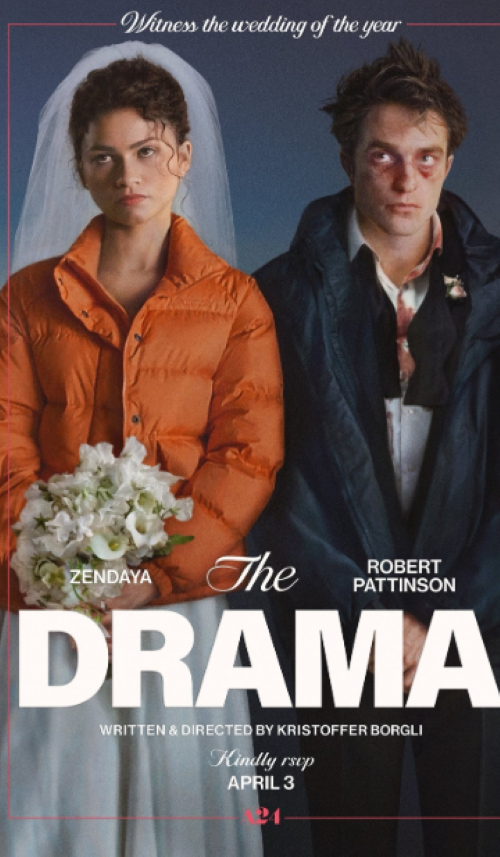
 Morally grey is the new black. At least it is in the new film The Drama (released April 3, 2026). Warning: spoilers ahead. We, as a society, are used to a few common archetypes of female characters: the femme fatale, the monstrous feminine, the eye-candy sidekick. What we are not used to is this new morally grey leading lady who leaves audiences deeply divided. The Drama combines two heavily charged and debated topics in society, mass school shootings and relationships, in an unforgetting and messy way.
The two characters, Emma and Charlie, are engaged and to be married in the very near future. During a wedding food and wine tasting, they play a game with some friends where everyone goes around the table to confess the worst thing they have ever done. When it’s Emma’s turn, she admits that she had planned a school shooting in high school but never carried through with it.
To everyone’s surprise, including the viewers’, it is the female that admits this. The film goes on to address how it is very uncommon for women to be mass school shooters, and how this would have put her in a minority of the stereotype. Our uncomforting feelings accompanying the topic itself are doubled by the fact that she is an outlier. Emma is female; therefore, she should not be in this position, right? The film addresses that, as other characters are claiming that this is not a female issue. So why is this unlikely culprit now the object of our suspicion and anger? The audience will have trouble grappling with this surprise turn of events.
This immediately puts the viewer and everyone else in the film in opposition with Emma. But just seconds before that, the film took the entire opening to set up the narrative that Emma was the most “empathetic” woman alive. To further this, the film was setting itself up to be a stalker tale. The film takes its time to show Charlie taking a photo of Emma’s book when she left her seat for a split second, then approaching her in the coffee shop moments after googling the book and lying about reading it just to talk to Emma and get a date with her.
It also shows their first kiss story when they were trapped in a small doorway of a museum, as alarms are blaring and the doors are locked, and Charlie suddenly goes to kiss Emma. The film cuts back to Emma and her friends at this moment, as she is recounting this story, because Emma’s friends point out that Charlie trapped her, but Emma swiftly steps in to come to Charlie’s defense and say it was just an accident they were trapped inside.
The entire beginning of the film was set up to show Emma in possible danger as she’s about to marry a man who may have stalked her. But within one second, one sentence, the narrative is flipped on its head.
So, what is the viewer to do with this juxtaposition of emotions? Two sides of the coin. We have just been set up to believe that this was a film with a dark secret about Charlie, but instead there’s an even darker turn regarding Emma.
Further shocking the audience, the idea of almost being a mass shooter but then deciding against it, is not a side of this topic that has had much light shed on it, yet. The audience will not know what to do with this bit of information. Especially given the fact that Emma has a near perfect appearance and manner about her, now, making it unclear if she is truly a changed person or a psychopath pretending to be normal. The film forces us to sit in the uncomfortable, the unknown. We are in an hour-long dilemma right along with Charlie, as he contemplates his entire moral belief system, worldview, and relationship to his supposed soul mate.
Charlie has a few flashbacks to times throughout their relationship where Emma has shown violent tendencies, and he begins to really question if the quickly upcoming wedding is something he wants to do. The audience is right along with him, debating if they personally would go through with the marriage to someone who seemed perfectly normal until this one shocking admission that changes everything. The film makes us uncomfortable, as this is a side of the gun control and shooting problem that many have not discussed or possibly even thought about before.
With this movie being so topical in today’s society, it also shows a turn for Hollywood’s female characters. The new morally grey protagonist woman is an interesting new archetype and one that will be interesting to see how modern audiences take. The Drama had a debut weekend domestic box office earning a total of $14 million (Variety). IndieWire reports that 80% of the audience for The Drama was under 35, with about 30% being 18-24. Plus, there was a large gender difference in the statistics, with 68% of the audience being female (IndieWire).
With the feminist movements and heavily female audience, it is possible that the viewers are progressive and open-minded enough to see both sides of the female lead, Emma. Perhaps people have been exposed to enough open-minded media lately that audiences are ready to watch a story about a multifaceted woman with a difficult past and questioning future. A 2025 study by Fokiya Akhtar & Azmat Rasul that was published in the Cogent Arts & Humanities Journal claims that “Audiences are more receptive to films featuring strong, complex female characters when exposed to such portrayals in the past.”
But it is also possible that Emma will be demonized more than other male characters, as has often been seen with the stereotypical monstrous feminine characters in literature and films. Emma is an easy target for misunderstanding and anger within the film, but one should ask if perhaps many of the other characters are also unlikeable or have unbecoming qualities to them. This entire film is a juxtaposition of good and bad, moral vs immoral, and funny but unlikeable characters, and Emma is another juxtaposition within this setting.
This movie could be a turning point for Hollywood’s writers if the modern North American audience is ready to face a strong leading lady who simultaneously holds such a strong contradiction within her. The question is: is the American audience ready to hold both darkness and light in a single character, especially a woman, and resist the urge to simplify her?
*****
Akhtar, F., & Rasul, A. “Empowering women on screen: exploring the influence of female protagonists on contemporary culture and gendered enjoyment in film.” Cogent Arts & Humanities, 12(1). (2025). https://doi.org/10.1080/23311983.2024.2444762
Gleiberman, Owen. 2026. “How ‘The Drama’ Could Redefine A24.” Variety. Accessed April 15, 2026. https://variety.com/2026/film/columns/how-the-drama-could-redefine-a24-materialists-the-invite-1236711571/
Welk, Brian. 2026. IndieWire. “‘The Drama’ Solidifies Zendaya as Our New Indie Box Office Queen.” Accessed April 16, 2026. https://www.indiewire.com/news/box-office/the-drama-zendaya-indie-box-office-queen-1235187553/?utm_campaign=feed&utm_medium=referral&utm_source=later-linkinbio
*****
Elisabeth Pignato is a college English Instructor in Florida.