
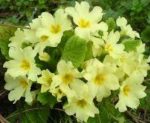
 April. Thursday. A free day. I am using it to do homework and catch up on my botany project. I have been gathering wildflowers and pressing them in a big dictionary between sheets of blotting paper. I am now preparing a label for a dried, yellow primrose–genus Primula vulgaris (family Primulaceae). The basal rosette of the flower is heavily wrinkled and the leaves have a dentate margin. The slender stem bears the delicate flower–a heterostylous hermaphrodite. My specimen is a pin flower waiting to be fertilized by a thrum flower. I glue it to the page.
Mirka comes into the room, picks up a book on Greek mythology, opens it to a photo of the Three Graces and looks at it. The women are naked. The one in the center has her back to the camera. The other two, one on each side, face the viewer. The sculptor has found their body curves. Their arms enlace breasts and round shoulders. Mirka says: What is it about? I tell her who the three graces are. She nods, closes the book and resumes her dusting.
The following Thursday Mirka comes into my room again, picks up the mythology book, opens it to the same page and says: Tell me more about the Three Graces. I say: Aglaia is brightness, Euphrosyne is joyfulness and Thalia is a bloom, like the primrose on which I was working. According to myth, they are Goddesses, the daughters of Zeus and Hera. . . . Mirka says she likes Euphrosyne, and then says: What makes you joyful? I’m taken aback by her question, and say that lots of things make me happy. She says: Such as? . . . I say: Oh, I don’t know, playing soccer, skiing, getting a good grade. She says: Do I make you happy? . . . I’m not sure how to answer, so I say: Sure, you make me happy. Then she says: I could make you happier. . . . She looks at the picture of the naked graces. Her black, green-tinged eyes look into mine. She holds my gaze, saying: Some other time. I have work to do.
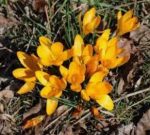 She leaves the room. I resume making a label for a dried deep-yellow crocus of the iridaceous genus Crocus, a showy, solitary flower, almost orange in color. The flower is cup-shaped with three stamens, and it tapers off into a narrow tube. Its grass-like leaf has a white central stripe along its axis. I glue it to the white page and insert it into the binder notebook next to the other flowers. Each page has a short paragraph listing the flower’s properties. This paragraph also refers to the mythology of Krocus, a mortal youth who was having a love affair with Smilax, a woodland nymph. Their affair angered the gods, and they transformed Krocus into the plant bearing his name. Smilax became a brambly vine with red berries, Smilax aspera. I think of the Greek word, krókos, meaning saffron, the yellow condiment. In my mind’s eye I see Euphrosyne and Mirka, then Mirka and Euphrosyne. Euphrosyne has Mirka’s black hair and black eyes–eyes that are tinged with a green iridescence. Berries and condiment. Desire and joy enlace each other with bare arms, and I picture myself dancing with the three graces in a field of primroses and crocuses. I am the faun and they are the afternoon nymphs. We cavort in a pastoral orgy of total abandon.
I hear Mirka in the hallway outside my room. I open the door and see her bending over the banister, dusting. I see her black dress and her round ass. As I approach she straightens up and turns around. A fleeting moment of surprise gives way to a demure smile. She has a tiny mole on her neck, on the left side. She takes my hand and says: Come. She walks me around the banister, down the hallway and into her room. She closes the door, cups my face in both hands and kisses me.
Her lips taste like red berries. I sense blood rushing into my cheeks. I am now Krokus with a hard on. She unbuttons my fly. I take my pants off. She takes her dress off, and I watch her remove her slip and panties. We stand naked, looking at each other. She is Euphrosyne, primrose and Smilax, spring and fall, myth and goddess. With trembling fingers I touch one breast. The touch is electric. She puts her arms around me and I put mine around her. We kiss–my boy’s body against her woman’s body. In the blue sunlight the colors of desire are pale yellow and dark orange. We lie down, she opens herself to me and I penetrate, coming quickly in the folds.
Neither one of us speaks. Mirka’s eyes are closed. Her unruly hair is spread across the pillow. I admire the profile of her nose against the light of the window. The wooden pieces holding the panes of glass are shaped like a cross, and the cross, suddenly, strikes a strident note. I hear two rasping tones: the voice of my father and that of my teacher, Brother Ignatius, both of them saying that the flesh is weak, that after illicit sex, and as surely as day follows night, there will be punishment in hell. Conflicting images of fear and lust compose a cacophony of sounds. Its harshness grates like fingernails on a blackboard. I get up, pick up my clothes and, clutching them tightly to my bare chest, walk out of the room. But not all the joy is gone, and, as I walk down the hallway to my room, I feel torn between the lingering lambency of Mirka’s body and the admonitions of stern voices.
Weeks pass. I wrestle with conflicted feelings of want and funk. On Wednesday fear of damnation triumphs, but on Thursday desire is the victor. Archangel and Lucifer visit me, and they play an infernal game in which they toss my soul back and forth across the five continents, from les sables d’olonne to the Himalayas. Archangel spreads powerful wings saying he wants to imprint the height and mass of the mountains onto my soul so that I will know, when the time comes for me to lick the summit, just how hopeless the task will be. He then kicks my soul into the firmament, this side of heaven, and it sails over the peaks and crevasses of Everest, bounces off Annapurna and rolls down a glacier toward the Vail of Kashmir, past fields, orchards and villages. It splashes into the Ganges and, buoyant, floats downriver past Benares, the city older than time. The temples and shrines shimmer in the holy waters. They reflect the rays of dawn. I smell incense and experience a fleeting instant of bliss not unlike the moments of joy with Mirka. My soul, refreshed by Varanasi and shining, drifts by Kashi, bonding with my body that is now flowing with the current toward the Indian Ocean. We pass by the teeming hives of Calcutta, enter the Bay of Bengal and, carried by the flow, cross the bay’s vast expanse, southward, only to be buffeted by the winds and waves of a typhoon. Archangel drowns me, Lucifer resuscitates me, and they both leave me helpless and forlorn in the limbo of the vast ocean.
West of Ceylon the currents carry me into the Arabian Sea and I find myself caught in the net of Oman fishermen. They haul me aboard their baggala and dump me with the fish into a stinking hold where I molder past the Horn of Africa, going north. The Red Sea. Five times a day I hear the faithful on the deck above my head, praying. I imagine them kneeling on threadbare rugs, facing Mecca. I come ashore in Nubia, stagger across the desert toward the Nile, board a felucca, sail downriver and catch a glimpse of three distant pyramids. We come into the Mediterranean, the lateen sail billowing in the wind. Lucifer steers me west on a course that hugs the African coast as far as Kairouan, the city where the sun bleaches all color into pastel shades of pink, beige and blue. There Archangel straps me onto a camel’s back for the journey across the sands of the Sahara toward Timbuktu. The camel’s gait pitches me forward and backward into a state of seasickness worse than anything on board the baggala. Day after day the blinding sun, scorching sand and whipping wind burn, scour and sting my bruised self. In Timbuktu I languish in the marketplace, rotting under a cloudless sky. A Bedouin on the way to Ouagadougou and Bangui picks me up. Merchants send me upriver into the jungles of the Congo where smiling pigmies nurse me back to health under the watchful gaze of Lucifer. He sits overhead on the thick branch of an African oak, his tail spiraling around the limb. No, it is the winged Archangel. He says: When will you repent? I say: I repent. Take me home. . . . And so it goes.
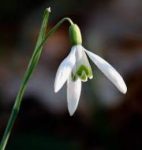 Another Thursday, and I am once again alone in the house with Mirka. Today, for my botany collection, I have two new, recently pressed flowers. A white snowdrop–Galanthus nivelis–and light blue forget-me-nots–Myosotis palustris. The snowdrop has two linear leaves on an erect leafless stalk. The pendulous bell-shaped flower emerges from a papery membrane, and the flower consists of three tepals and a three-celled ovary that ripens into a three-celled capsule. The seeds are whitish and they have small, fleshy tails. The forget-me-nots have small, flat, five-lobed flowers, bluish-white in color with yellow centers. The seeds are located in small tulip-shaped pods along the stem, and the flower’s name derives from the Greek: mouse’s ear, due to the shape of the leaf. According to German legend, when God named all the plants, a tiny unnamed one cried out: Forget-me-not, O Lord! And God replied: That shall be your name: Forget-me-not. . .. I glue the flowers to sheets of paper, label them and insert the new pages into the binder notebook. My collection is growing. I am proud of the specimens and my efforts in finding and labeling them. I picked the primrose in a shaded dell next to a brook, and the crocus on a grassy slope beyond the pinewoods. The snowdrop emerged on a knoll next to a patch of snow, and the forget-me-nots appeared in a vale with ferns. My crocus was a fall flower, unlike the other three. From September to April I have been roaming the countryside looking for specimens. I feel certain that Brother Ignatius will give me a good grade.
Cool fingers close over my eyes. Mirka’s voice says: I like forget-me-nots. I touch her hands with mine, stand up and turn around. She looks into my eyes with her black eyes–a look that sweeps Brother Ignatius’ words away like autumn leaves, and my good intentions with them. I feel myself falling into a vortex that says yes. Yes to love, yes to the seam of Mirka’s panties, the touch of her bare thigh, and yes to the imperious longing within me. I follow Mirka into her room and we make love, fast urgent full-bodied love with hands, lips, teeth and skin until the coming, scalding rays of the blue sun meld our bodies together with gasps that are now decelerating toward the slow breathing of our naked selves. Her breasts rise and fall, she looks at me, smiles and says: You make me happy. I say: You are my snowdrop.
Photography Credit: the top featured image: Jason Rice (detail)
Ben Stoltzfus is a Professor Emeritus of Comparative Literature & Creative Writing at the University of California, Riverside. He is a novelist, translator, and literary critic. He has published 12 monographs of literary criticism and has received a fair share of awards: Fulbright, Camargo, Gradiva, Humanities, Creative Arts, and MLA. He has published six novels and two collections of short stories. Most recently, Romoland, a pictonovel (2017), was written in collaboration with Judith Palmer, the artist; Falling and Other Stories (2018), Dumpster for God’s Sake (2019); and Alliecats: Graphic Tales, in collaboration with Allie Kirschner, the artist (2019).