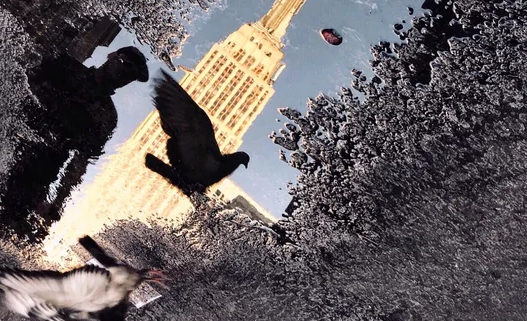

“Two birds on a roof,” Colleen said.
We used the trashcans to hop on the roof of the garage. There wasn’t much to see up there, and it didn’t make the neighborhood look any different. Old, narrow houses stood too close to each other like a huddled crowd of sick people. The windows made me think of sad eyes. There were never any dogs or children in the small cramped yards. But I no longer thought someone could get stuck here, that a street like this could keep you trapped in one place. Colleen even called us birds, and I pictured us as two tiny ones side by side, wings fluttering, when I saw a flock of black birds take off against the storm clouds.
“Happy birthday, little brother,” she said after cracking a can of beer. She clanked hers against mine and looked at the back of the house. A greenish, black mold covered the vinyl siding. The shingles curled up like dirty feathers. When I turned back to Colleen, I found her staring at the window on the right. Her eyes were wet with a feeling I couldn’t name. She would never tell me or anyone what she was feeling. You’d only get pieces that you’d have to put together.
“He’s asleep. Thought I heard something,” she said.
“You need a baby monitor,” I replied.
“I know.”
“Let me get you one.”
“Look at you, Mr. I-just-turned-twenty-one,” she said. “Drinks his first beer and thinks he’s all grown up now.”
“I’m way past my first.”
“Show me, college boy.”
My sister was so careful and private about herself that our talks often tripped into the deep ditch of hostility the two of us had made when we were young. I would follow her around the house, into her room, and outside in the woods or an empty field until she’d scream and slap at me, and I’d run away crying, my tears the final say for my parents to demand an apology from Colleen. The green of her eyes were hazy and dense as if a strange fog drifted inside her. There was never any answer or clue that came out of her eyes. They let so much light in you’d think something would show itself, but she gave you nothing, and there was only a bright haze that made you dizzy. I raised my can, ready to down the rest of the beer.
“I’m fucking with you, bud,” she laughed. “Always been more book-smart than street-street.”
“Yeah, yeah.”
“Aren’t communication majors supposed to be, like, more articulate or something?”
“Oh, fuck you,” I said like it was just a dumb joke, but felt the sting of truth in my throat.
My car was parked in the driveway. A used, beaten down Camry that I bought before moving away. Colleen was quick to remind me that Dad paid for half of it as well as the insurance. He’d never do that for me, she had said. If I left now, I’d get back to campus by midnight and find my friends at the end of some party. I took a long sip of beer to drain out the sting—it now felt more like guilt than truth.
“Fuck me for what?” Colleen said. “It got you in a good school, didn’t it?”
The way she said good school made me crane my neck. Our voices seemed like the only sounds below the descent of the storm. In the distance, you could hear a faint rush of traffic on the busy road. But we were the only things out in the neighborhood tonight, and the sound of her voice in the mute stillness almost made me throw the can at the house to wake my nephew. She could always turn over any word and reveal a colony of ugly insects crawling over one another. Her words were sometimes gifts, too, that you wrapped and rewrapped in your head until she turned one over again and made you cry and run away.
“Didn’t it?” Colleen said.
“You make it sound like I’m a pussy.”
“I never said that. I was just messing around, okay. You exaggerate everything, you know that. I say one little thing, and you’re all pissed off.” She let out a sour laugh. “Just like the old days.”
Purple and swollen clouds inched closer to the houses. The remaining twilight would soon be swallowed in the dark of the storm until tomorrow morning, when I’d have to drive back to campus and get ready for the end of the spring semester. Summer break crept up again, always so sudden and subtle, and I debated if I should come home or find work near school. Last summer felt like I was sixteen again. Afternoons spent in front of a computer in the library, looking up places to visit. I saw my future myself leading exotic tours, my wife somewhere in the far back of the tourists, embarrassed by my jokes about her line of work and her favorite movie. The days were too long and free, time stretching on like the endless farms and fields around the house. Aside from my trips to the library, I had nothing to do but wait until August. I was alone in the house with my parents, and the only other company I ever had at home used to be Colleen until she moved a few towns away. There were mornings when the sound of my cereal clinking into another empty bowl made me feel so dull and helpless that I could barely eat.
I didn’t have a girlfriend to keep me away from home either, and I was still a virgin then. The fact of that shame brought on a deep burn in my neck. At night, in bed, the burn would travel down my stomach and smolder between my thighs. Sometimes it would keep me up for so long that I had to drink it off or surrender to the private humiliation of watching porn, my phone glowing in the dark of the room, my headphones loud enough to hurt my ears. The feeling was most acute with Colleen, too, but it had nothing to do with sex or attraction. Whenever I was with her, I felt this deep need to prove something to myself, to be something real, and once I could do that everything would change and I wouldn’t have to lay in bed and wait through another long night for the real thing in me to be born.
“He looks good,” I said, referring to my nephew.
“I still can’t believe it,” Colleen replied. She pulled her rust colored hair over one ear. “He’s the best thing that ever happened to me. Aren’t you,” she said to the window. But there was something bitter crawling under those last words. I could hear it. “You think you’ll have kids one day?”
I said maybe and then, just to change the subject before she could dig deeper, I added, “I’ll have to see what it’s like being an uncle first.”
She squared her shoulders and threw her hazy, bright eyes on me.
“I never asked for anyone’s help,” she said. “I’m fine on my own.”
“All I said was I wanted to be an uncle.”
“Then just be an uncle,” she replied. She looked away and shook her head at the dirty backyard next door. “Trash,” she muttered. “Did they send you here? Don’t bullshit me. Is this sleepover their little way of checking up on me?”
My mother had said to text her that the baby was all right, and my father needed to know if Harris, my nephew’s father, was still living with Colleen. The last time I was here I left with a busted lip. I had told Harris that if he was only going to be here when it was convenient for him, then he could fuck off. He was smoking a cigarette in the backyard and the night was cold and dry, a wintery air that bit at your hands and mouth. He had a nose ring and he wore white jeans with tiny tears in the pant legs. Trash, I thought. I never understood how my sister ever picked someone like him, how she had defended him when I told her he was trash. He’s himself at least, she said, and when I asked her what that meant, she told me to stay out of it, that she could handle everything on her own, and ever since that night, she was suspicious about any time I brought up visiting.
“If you didn’t want me here, you could’ve just said so,” I said.
“I want you here,” Colleen said. “But it shouldn’t be because of Mom or Dad. I want you here just to be here. Not to check up on me.”
I assured her as best I could that I only wanted to visit. Our parents, though, had said they hadn’t spoken to Colleen since the winter and they were worried. And I was worried, too. And I wanted to hold my nephew and feel something real in my hands instead of going through the same old weekend drag of parties and hangovers on campus. Lately, I had this sense of losing myself. Some part of me gathered dust in a dark space. On the drives back home, I’d pass through desolate stretches of cornfields and silos and windmills before the small towns and suburbs popped up on the blank horizon of the Midwest, and I’d think that missing part of me was out there in the fields.
“I wouldn’t put it past them,” Colleen said. “They’ve always trusted you.”
“I never got caught. You did.”
“Caught doing what?” She crossed her arms and raised one eyebrow. I wondered how many times I had met her face, how hard I had looked in her eyes, and there was nothing familiar, no apparent likeness of our family in her, not in temper or bearing, and only so little in general looks that people outside of our town, strangers like Harris, might be surprised to learn we were related. Don’t look that alike to me, Harris had once said. “Yeah,” Colleen laughed, “it’s easy getting away with shit when all you do is glue yourself to a computer in the library.”
“I mean now,” I said.
“You could do anything now,” she said. Gingerly, her fingers pinched my cheeks before I could pull away. “Go ahead—set the house on fire, crash your car, kill an old lady. They wouldn’t mind at all. Not with you.”
Her words dug into me. No matter how much I hated to hear them, I had to admit Colleen was right—our parents put me before her because I was the one they could handle. The easy one. At the dinner table, I would show a list of new places to my parents and I’d explain why someone should go there as if I was selling them a trip they could never afford, and they would act so interested that they’d sometimes pretend they could take me there one day. It reminded me of when I was little, how I would prepare presentations for them in the living room on why I should have a little brother. Colleen would laugh at me and throw pillows from the couch, and my parents would send her away so I could stop crying and finish my presentation. I realized then, as my parents played make-believe with my research, that I couldn’t stay close for school. That if I stuck around, I might never get out of here, only speaking to my parents about places to go.
The first weeks of my freshman semester proved how sheltered and isolated I had been at home. I hid my modest, dull homelife beneath a cozy image of a suburban house with a hot tub. There were such casual conversations about trips to southern beaches and European cities that I made up our own family vacation to Florida just to make connections. I told my roommate a story of losing my virginity in my car during a high school dance. I didn’t want to be seen as anything unlike the crowds around me. I didn’t want to be trash, to sound dull, or to look pitiful. My lying gave me a way to make friends for the first time in my life, and since then I’ve always taken that cliché of college as a second home very seriously.
And I often thought of Colleen when I started school and what she would do in my place. I pictured her beside me sometimes, taking notes in class, sipping from a red cup at a party. On campus, she would take no shit and put everyone in their place, and she would never hide the way I did, and she wouldn’t give one fuck about it. In that way, she was like our parents, because they’d be disappointed to learn about the pretense I was keeping up just to fit in.
“I’m not perfect, Colleen,” I said.
“You’re closer to perfect than I am, that’s for sure.”
Our parents kept constant watch of Colleen. She stole money from our father and once gave our mother a ghastly haircut in the middle of the night to get back at our parents for grounding her over poor grades. Her disobedience turned to more adult excursions involving alcohol and boys after curfew hours when she was older, and it wasn’t long until she broke free from the house for good and met Harris and shifted through different dead end jobs and half-baked plans about going back to school. When I moved away, I first believed she envied me for being the one to go to college in the family, and that she blamed herself for not setting the example as the oldest. But now, being with her on the roof and thinking about the fake image I hid behind at school, the feeling reversed itself. I wanted to be like her, someone who exploded and raged always as her true self in any moment of freedom. My parents knew I could handle freedom because I did nothing with it. I was safe and secure, I was predictable, I was afraid.
“It’s obvious,” she said.
“What?”
“You’re the favorite. Their little boy.”
Slight, soft cracks of thunder sounded like far-off drums beating above the houses. I could feel the weight of the storm bearing down on us. When we were little Colleen and I had to share a bedroom. I was very young, and I could only recall what the room looked like after she was gone, but any time I found myself below an oncoming storm, I thought of us in the room, a boy and a girl on each side, rain on the roof, lightning in the window. I could see myself getting scared in the dark, crying in bed, and just before I could yell for Mom, Colleen would say something like It’s just a storm, crybaby. Nothing’s wrong. Shut up and sleep. Her voice sounded tender and kind, and if I replayed it enough times I could feel her whispering in my head. I almost asked her if that really happened, but then I wanted to keep it for myself, to hold on to it when I was alone in bed again. Even if it never happened, just the idea, just the picture of us in the bedroom during a storm had seemed so real in my head that I couldn’t let go of it.
The road, crowded with cars and littered with trash, made me feel small and trapped, but I thought of what Colleen said earlier, how we were birds on the roof, and I could almost feel the two of us rising toward the darkening sky, unafraid of the storm.
“What the hell are you smiling at?” she said.
“I’m a big boy now,” I joked, then took one last gulp and crushed my beer. “See?”
“Just like that.” Colleen snapped her fingers. “Turns twenty one and thinks he’s all grown up. You still got a long way to go, buddy.” She finished her beer. “Long way.”
The last of what she said had turned over and sent bugs crawling up my legs. I could push her off the roof right now, watch her fall face down. I looked up at the window of my nephew’s room. What would she say to him when he was afraid? The image of us in our old bedroom returned, and this feeling went through me, blowing like rain and wind, and it occurred to me how much I needed my sister, that I came here not for her sake, but my own. I dropped the crushed beer, my hand trembling as thunder rolled down my shoulders. Colleen held out her hand.
“It’s raining,” she said.
She walked to the edge of the roof and swung her feet down to the trashcan. The rain picked up and the air was cool and damp. My eyes landed on the window. I thought if I stayed there on the roof the storm might hold off and turn away from the house, the thunder dying in the distance.
I heard my name.
“You coming?” Colleen said from below.
We went inside and stayed up for the storm. It never came. Only a stillness had fallen and put the night at rest. I made a bed on the couch in the living room and lay awake in the dark for some time, waiting for the storm. I thought about my friends at school, what they would think if they were on the roof with me and my sister, and I thought about what would happen after college, if I’d still be the same kind of person. It was hard for me to breathe, as if a stone had been dropped in my chest, and the silence of the house had a density of unpassed time. But sure enough, the next day was coming, and the one after tomorrow. And the night around me was so still that I knew everything would be different after this, that tomorrow I was on the brink of some great change I couldn’t yet understand but was beginning. And I kept feeling the storm would come, waiting in these unending pauses throughout the night—the stillness that holds on before a storm breaks—and I waited, I waited for the rain and the lightning, I waited for the cries of my nephew and for the voice of my sister, and all I could do was hold on and try to breathe.
*****
Tom Roth teaches creative writing at a middle school in Cincinnati, Ohio. His most recent publications are in Allium, The Baltimore Review, BULL Magazine, and Everyday Fiction. He earned an MFA from Chatham University.
