
Clara’s movements in her prized woolen dressing gown were measured. She was making her Sunday morning tea and did not want any spills to stain the robe. It was her only material possession, besides photographs, from her trip to Italy thirty years ago. Not that the tea was likely to spill. Clara had put only the necessary amount of water in her tea kettle to make one cup, and she was using a teabag, so no messy straining of loose tea leaves necessary. Back in her childhood, in 1950s New England, her mother and older sisters had brewed large amounts of tea with loose leaves for her seven person family, but as Clara was single, a teabag was more efficient. And it was easier than loose tea leaves to use more than once. This was the second use for this particular teabag, so it went into the trash. Occasionally Clara treated herself to Earl Grey tea, her favorite, but then she used each teabag three times.
For breakfast Clara sat at the counter of her galley kitchen. For dinner or when she had guests she used a table in the main room, but she rarely had guests. Besides the main room and kitchen, Clara had a bedroom at the other end of the apartment. It had originally been part of the main room, but before she moved in the landlord had partitioned off a section as a separate room. Clara’s previous apartments had been efficiencies, so she was glad to have a real bedroom.
Clara kept this apartment neat and homelike. Her plants were arranged along the windowsill, her stereo system nestled on a bookcase, her books arranged by subject and alphabetically within each subject, and her photo albums on the coffee table.
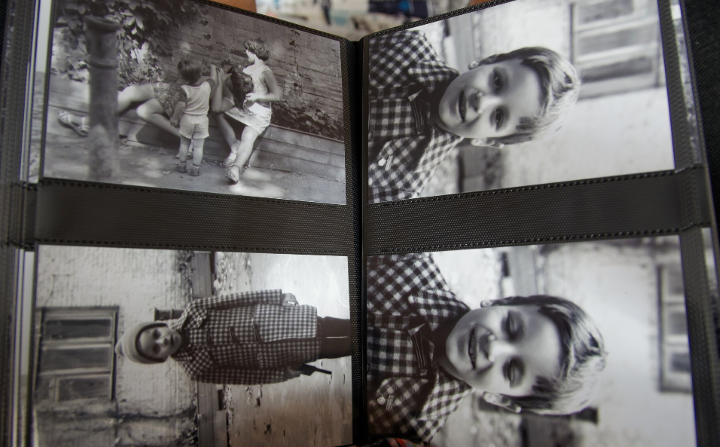
She spent a lot of time on photo albums. Her parents were dead now, and her aging sisters rarely visited her quiet little suburb of Philadelphia, but she had compiled photo albums of them. She also made albums for other people. Her coworkers brought her pictures of their families or vacations, and she would arrange them into albums for them. They would pay the cost of the albums, but she enjoyed giving her labor as a gift, some of the time.
Her most cherished album of all, and her most cherished memories, were of her trip to Italy when she was in her twenties. It was the trip of her life. She had to live at home for two years saving money for it. She gathered materials on the places she wanted to see and organized them in binders. She had always wanted to travel. She loved reading about foreign countries. When she finally had enough money, her heart pounded as she booked the trip. She could hardly believe she had done it. Her family thought it odd to spend so much money for a trip, but her oldest sister drove her to the airport.
“Here we are,” her sister said as she pulled the car under the big overhang at the departures section. “I’ll be here to pick you up July 16, and then you can save for an apartment.”
The airport. Such a busy, bustling place. Clara found her flight on the monitor and proceeded to the gate. She looked around at the people in the waiting area there. They would be her shipmates on the plane. The flight itself she treasured. She had heard airline food disparaged but she thought it was delicious. They even had classical music on the earphones. The flight attendants were so helpful, so friendly. Her fellow passengers were amiable – she had a long conversation with her seatmate – and they were all going to Italy.
She had ridden trains to Venice and Florence and Rome, staying in pensiones. She had eaten at bakeries and cafes and seen the great sights of which she had read so much.
Eight days into her trip she was sitting in the breakfast room of the century old pensione boarding house where she was staying in Florence when the middle-aged, pot-bellied proprietor smiled at her and said in Italian, “Signorina, here are some young girls just like you. Why don’t you join them?“
She looked over at the group of young American women laughing and chatting across the room, sure they did not understand the Italian words. But seeing her look, one of them waved and said, “Come on over.”
She had hesitated, feeling it too forward, but the young women had chorused, “Sit with us,” and she had moved her chair. They were going to see the David statue and the Duomo that day and as she was too, she joined them for the day. Like her, they were planning to travel south in the next couple days.
“Why don’t you travel with us?” one of them said.
The others nodded. “Yes, do. Why not?”
She could not think of a reason why not; they were all scheduled for the same train. She sat with them and then traveled further south with them. She rarely changed plans but customs seemed less constrained on this trip. In Rome they rented motor bikes to trace the route that Ethiopian runner Abebe Bikila had run barefoot to win the Olympic marathon two years earlier, and Clara rode with her hair streaming out behind her She could hardly believe she was doing it, felt a tantalizing thrill but was glad her family didn’t know.
She struck up a friendship with a woman her age who had also come to Italy alone and had attached herself to this same group, just a day before Clara had. This woman, Eliza, was a graduate student in archeology at the University of Georgia. She had studied several languages and spoke Italian fluently. Clara was very impressed with her. And they had a shared interest in photography! She and Eliza roomed together and Clara told her how she had taught herself Italian and showed Eliza her binder with charts she had made of sections of Pompeii and Herculaneum.
“You’re so smart! Such a scholar!” Eliza had said. Clara felt her body warm and relax under the praise. Eliza encouraged Clara to study further, to apply to college and pursue a profession. Clara had laughed; no one in her family had gone to college. Most of her high school classmates had taken clerical jobs as soon as they were out of school, and so had she, though she had taken an evening course in library science at the community college. Now she was traveling with women who assumed they would have professional careers, and who viewed her as smart and educated like themselves.
As she watched the ripening vineyards of Compania from the window of the train to Naples, Clara felt herself blossoming too. She was in Italy, land of the Romans, on a journey that had lasted thousands of miles and that had led her to new, fun-loving, eye-opening companions.
Sunny days had followed. They had seen the Cathedral of St. Januarius and ancient subterranean Naples. They had crept through catacombs. Clara had been alive with excitement through these archeological wonders, and never more so than at Pompeii.
She had spent hours watching archeologists working on the site. She got up the nerve to ask them questions. She was so entranced by that archeological site that she altered her trip schedule. Normally she never altered schedules. But this time she did in order to stay at Pompeii several extra days.
Eliza had talked the archeologists into showing them around. They and Eliza had had lively discussions. Eliza showed them Clara’s Pompeii binder and they were impressed with how well organized it was. During their discussions, it transpired that the archeologists needed some extra hands to catalogue ceramic shards and they allowed Clara and Eliza to do some of that work. It suited Clara’s detail-oriented mind and she loved it.
At the end of their third day, the lead archeologist asked Clara if she would stay on for another six weeks. They’d pay her.
Clara was thunderstruck. “But I don’t have a work visa!”
But the archeologists had permits that allowed them to hire help for specialized tasks.
“Where would I live?”
They had accommodations.
That evening Eliza had dug into Clara, exhorting her to take the job. “You have library skills! Data management is a big part of archeology projects. They need you.”
Clara shook her head. “My Italian isn’t good enough.”
“Your Italian is fine and everybody on the project speaks English. And they want someone who knows English well to work on the indicis.”
“I can’t leave my job that long.” Clara had sat down on her bed and Eliza stood over her.
“You can get another job. You can type, you’re detail-oriented, and you have an employment history. But you’ll never get another job like this one. You can leverage this work into getting into college. I am sure they’d write you a recommendation. You could train to be a teacher, a librarian, or even an archaeologist.”
“An archaeologist?” She couldn’t imagine jumping into something like this. She had never even met an archeologist until this week.
Eliza had gone on, relentlessly it had seemed to Clara, while Clara folded and unfolded her hands. “It’s only for six weeks. Take a chance. Go for it.”
She sat down beside Clara and continued in a softer voice. “Some of the work will be done at the University of Naples. You liked there.”
She had. They had walked through it on their first day in Naples and the old buildings with their rows of arched windows and their Baroque friezes had delighted her. The thought of studying there, or working there, with real scholars was something. For a moment she imagined herself walking among the pillars of those venerable buildings, strolling down the avenue of the botanical garden, discussing Pompeiian history with Italian professors and world-renowned experts in ancient ceramics.
But to change her schedule so completely just like that? Write to her employer and say she wasn’t coming back? Announce to her family she was staying another six weeks? How would she even get word to her sister in time, her sister who would be looking for her at the airport in two days?
“But I’m not a graduate student like you! Why don’t they hire you?”
“If you don’t take it, I’ll ask them to.”
And Eliza had. Clara had returned home on schedule and placed a picture of herself and Eliza in the Piazza della Signoria in the front of her scrapbook.
Still, it had been a wonderful trip. Clara looked on it as the highlight of her life.
After breakfast she worked on the photo collage she was making for her boss, of his two sons. “You’re good at this kind of desk jockey work,” he had said when he asked her to do it. Her boss was the librarian at a Catholic high school and Clara was his assistant. She catalogued books, processed orders for new ones, and helped students find books and magazines. She liked being part of their education though the job’s modest salary did not allow her an unconstrained lifestyle.
She put down the collage when the mail came. There was a paper listing local events and Clara looked through it. She enjoyed reading the movie reviews and occasionally treated herself to a night out at the movie theatre. She saw a notice that that afternoon a nearby college was holding its commencement ceremony. The speaker was a priest from the same order as the nuns who had run the high school she had attended.
There were several people getting honorary degrees. The name of one of them caught her eye. Elizabeth Murphy, an archeologist. Could that be Eliza? Her last name had been Murphy. The paper didn’t say anything more about this woman.
Clara had been planning to take a trip to the library and to go grocery shopping after she finished with the collage. But now she wondered if she might go to this commencement ceremony. It was open to the public. She had not been in contact much with members of the order since leaving Massachusetts, and it would be nice to at least see some of them again.
Yes, she would do it. Change her schedule. See if this was the same Eliza. If it was, maybe she could speak with her after the ceremony.
Clara kept glancing toward her Italy trip photo album while she ate her sardine sandwich for lunch. She never held her photo albums while she ate lest something spill on them, but as soon as she finished she leafed through the pages showing Eliza and Pompeii.
She dressed in an old navy blue suit and slipped her camera into her purse before leaving her apartment. Maybe she could get a picture of Eliza, if this was Eliza, to add to her collection.
She took the bus (she knew the schedules very well). It let her out by a church near the college campus; from there it was an easy walk.
The campus was bustling. Flowers were everywhere, in pots and in the ground, transplanted the week before. Vines were wound around lampposts. Throngs of people college-aged and a generation older moved toward the college green.
Clara reached the seating area, took a program and looked for a seat. Seating was open, except for an area roped off for the graduates and dignitaries. Clara seated herself in the center section near an older woman who also seemed to be alone. She started reading through the program. Elizabeth Murphy had done her graduate work at the University of Georgia. It must be the same one! Clara drew her breath in with an excited little gasp.
“Is this your first one through?” the other woman asked her, smiling.
“Oh no,” Clara said.
“This is my tenth one through. I have eleven grandchildren.”
“Oh, you must be so proud. How wonderful for you. Where did your other grandchildren go to college?” Clara often turned a conversation to others, as if to draw on their fuller lives to enrich her own. This woman was happy to talk about her grandchildren, who were all taking up professional careers and doing interesting things. One was working on cancer research, and another on development efforts in sub-Saharan Africa. Several were married, and the woman looked forward to great grandchildren. The woman did most of the talking while Clara responded occasionally, prompting and congratulating.
In this manner Clara and the elderly woman – Clara thought of her as elderly although she was probably only ten years older than herself – chatted for several minutes, until the woman’s husband came along. Clara offered to move so the two spouses could sit together. Back in the aisle, she looked for another seat, preferably one from which she could make her way to the stage area afterwards. Seats were tight by then, and she ended up pretty far from the stage. She didn’t think she would be able to push through all the people between her and it, but thankfully her camera had a telescopic lens so she could at least try for a picture.
This time she was next to a couple about her own age, wearing matching business suits. They took no notice of her. “Last one through college. Now we can do some real vacationing,” the man exclaimed, throwing his arm around his wife.
The college chaplain opened with a prayer, and the college president introduced the valedictorian. That young lady was from Boston and her accent reminded Clara of her childhood home. The valedictorian spoke of the importance of aspirations, and Clara thought back to how in her early teens she had dreamed of becoming a travel writer. At least she had worked in a library and had been able to read about foreign places all she wanted. And she had her trip to Italy.
The graduating class president spoke on the same general theme, and then the main speaker came to the podium. He was wearing the brown robes of his order, and again Clara was reminded of her childhood. She settled back in her chair, remembering sitting through sermons in her youth. She was not prepared to be entirely attentive to another speech. Only some of his phrases bore in on her consciousness.
“Christ said do not hide your light under a bushel but let it shine, … Emulate the courage of the apostles…”
Finally he was done. The college president came to the podium again to announce that there would be more quick speaker. One of the honorary degree recipients, a woman whose work on the archeology of the Dead Sea Scrolls had so informed our understanding of the Holy Scriptures, wanted to say a few words.
This woman walked briskly to the podium and Clara looked at her intently. There was Eliza, thirty years older. She appeared to be glowing; the sense of excitement she had exhibited thirty years ago was evident now as radiant self-confidence.
She had had to add something to the valedictorian’s comments on dreams, she told the audience. “What you have an opportunity to do something you never thought you’d be able to do, take the chance!” Clara’s short nails hurt her palms as she clasped her purse strap tightly. “Even if it wasn’t quite what you had in mind.” She had never anticipated doing Biblical archeology, she said, but she had met some archeologists in Pompeii and they had introduced her to some Biblical scholars.
“I was touring Italy for fun. But when I had a sudden, unplanned chance to join a dig in Pompeii I thought, ‘Go for it!’ I stayed three months! Made contacts that lasted to this day!”
Clara’s shoulders slumped. She hadn’t retained any correspondents from her trip to Italy. She had no desire to listen further. She stared at the back of the chair in front of her.
Now the graduates were being pronounced graduated, being given “all the rights and privileges thereunto appertaining.” They would pick up their diplomas in more intimate departmental ceremonies. The college president asked all to rise for the benediction, and Clara obeyed with the others, glad for the sense of anonymity in the group response.
The college chaplain came to the podium again. “Please reach out to loved ones,” he began.
Family members moved closer together and held hands in response. The couple next to Clara were in a close, excluding embrace. Clara glanced around. It seemed that everyone in the large audience except her was holding hands with someone. All the people around her had moved away from her in order to be closer to their own loved ones. She alone of that whole crowd was standing by herself. She had always taken comfort in group prayers but now felt as if the blessing was directed at everyone but her.
After the chorus of Amens she put her program down and moved to the aisle. She walked toward the back of the seating area, and from there to the path which would lead her to the bus stop. She passed many families hugging their graduating member, or smiling and snapping pictures. Her own camera lay in her bag. She reached the bus stop and waited for the vehicle which would take her back to her apartment to tend her potted plants and photo albums of long-ago trips and other people’s children.
*****
Gretchen Cowell is the author of the nonfiction book, Help for the Child with Asperger’s Syndrome (Jessica Kingsley Publishers), several nonfiction articles and columns, several pieces of microfiction published by Vine Leaves Press and a short story published by Killer Nashville Magazine. She lives in Philadelphia with her family.