Author Preface: Benita Raphan (1962-2021) and I became friends when she, as a high school sophomore, took me under her wing during my freshman year. She was a loyal, proactive ally. A few of her films and more about her life can be found on benitaraphan.com, which describes her: “An interdisciplinary artist who searched for answers about where creative ideas come from…Her subjects included Paul Erdos, R. Buckminster Fuller, John Nash, Edwin Land, Helen Keller and Emily Dickinson.” Benita’s mentor, documentarian Alan Berliner, debuted his documentary about Benita in fall 2025.
***
I flew in for the premiere screening at DocNYC, the movie’s title your first name, “Benita.” Your mentor Alan made “Benita,” spurred on by your family, who gave him all your hard drives and archives. First, they’d asked him if he’d complete the movie about canine cognition; you’d won a Guggenheim Fellowship for that on the basis of a proposal and your impressive resume. He said he couldn’t finish the canine film but would work on another film to honor you and filmmaking. As he spent a year poring over your recordings, he found you talking about changing your Guggenheim film’s subject to Covid and mental illness. The film he ended up making about your illness, both mental and from Covid, became an unspoken collaboration between the two of you.
Before the movie, Max and I dined with your and my other constant companions from the Bronx High School of Science, who were a couple back then, Eric and Ira. The conversation was light-hearted. Eric sat next to me and mentioned sotto voce that he’d had lunch with your mother about a year ago. She’d wanted to talk.
She, your sister, and your sister’s family were at the screening. Your mother is 96 now, looks and sounds wonderful. Still, that can’t possibly be the whole story, I thought as I held her hands on the sidewalk outside the movie theater after the screening. Since you’ve been gone, Alan developed cancer, for which he now has quarterly visits, to see whether it’s still in remission. Earlier this year, your best friend Lucy lost her husband to a heart attack. So many things we couldn’t have predicted and that you left before seeing, from how long the pandemic trudged on—we’re still getting vaccine boosters and my brother-in-law has had long Covid twice— to Trump 2.0, against which there is no inoculation and many have and will suffer and die, bothhere and globally.
The movie showed both your delight and your weariness. The delight showed most when you were training your dog Rothko, methodically rewarding him and praising him when he accomplished his tricks. So full of life! Alternately, I saw the weariness that spread over your face in the pandemic-time shots: your undereyes gray and puffy, dragging you down. So drained of life.
You left in early 2021, did an Irish exit forever. You had an obit in the New York Times, earning it through your artistic achievements. In it, your mother described you as “an irregular verb…Benita could take something ordinary and find beauty in it…Her heart was right out there.” I wish you could have seen the obit or could have seen “Benita” for that matter.
On and off, because it’s too sad to think of more than occasionally, I try to imagine how you got to the point where you were okay with your mother finding you hanging in your apartment, your dog alone but not alone. As a psychotherapist, I know that confidentiality is only broken when there’s an imminent danger. Your mother said, in the film, that on the night you died, your doctor called her to go over to your apartment to check on you.
I can get closer to the “I want to die” feeling by remembering June 6, 2006. I’d chosen to have surgery because I wanted to live. I wanted to live without the potential deadly consequences of my BRCA1 mutation that killed a number of my ancestors including, eventually, my mother. The surgery had removed all the parts that could grow gynecological cancers, and my breasts had been emptied out, with tissue expanders inserted in them for later saline implants. When I came to in the hospital recovery room, I was screaming from the pain. I was vaguely aware that the staff wanted me to put a sock in it. I was as thirsty as if I had to crawl across Death Valley in search of water. If those feelings had continued unabated, and an “Off” switch was within reach, I might have flipped it. I might have somehow forgotten about my husband waiting anxiously for me to emerge from the recovery room, might have forgotten about my then three-year-old son who was blissfully clueless with my in-laws back at our house. More people would have been affected by my absences, but in those moments, they didn’t exist, only my pain did.
Is that what it was like for you? I look up Mark Rothko to see why he committed suicide, as if anyone can know. “He was increasingly isolated… and felt lonely.” Because of an aneurysm, he couldn’t make the kind of paintings he wanted to make, he used to make. You had Covid in the spring of 2020, pre-vaccines. What effect did that have on your mental health, your cognition, your artistic ability? You’d been isolated for many months, and you’d recently lost your admin position at the School of Visual Arts; I was unsure whether this was because of Covid cutbacks or your performance. You were worried about money. You had more mental health struggles over the years than I was aware of. Your friend Lucy said that you’d been hospitalized in the fall of 2019 and found that relieving, maybe because it limited your choices. It was only a few weeks before your death that you and I emailed about you joining my Zoom book club. You didn’t live to see the next meeting.
The day after the “Benita” premiere, Max and I visited your old boyfriend Eric (not to be confused with gay Eric) and his wife. I hadn’t seen him since the early 1980s; in the film, Eric had told Alan that he and you were very much in love. He wouldn’t be watching the movie about you until the next day, so I didn’t tell him that in one shot is an excerpt from your journal: “I should have married Eric Hoffert.” Eric has been together with his wife Sara since not long after your and his relationship. They have a thirty-year-old daughter who has an apartment with her husband in the same building. If I pretend, I can see you having lived in this parallel world with him, but deep down, I don’t know if you were capable of that kind of closeness with someone, in the complicated architecture of a healthy marriage and family. In what I read about Mark Rothko, it said his marriage was flailing when he said goodbye to the world. Maybe, however, a marriage and a family would have tethered you to the world, made you feel as if you had to go on.
By staying alive after my hospital recovery room nightmare in 2006, I’ve been able to see my son Eli grow into a 22-year-old mensch. He’s been adulting with a Fulbright at the University of Copenhagen, studying pipefish genomics. You were sweet to him when he was a little boy; I still remember you riding the Central Park carousel with us. I remember a red velvet heart pillow you sent Eli—what happened to that velvet pillow? You loved your niece and nephews so much. You adored all canine creatures. You were always happy for other people’s good news, even when they had a situation you may have wanted for yourself but didn’t have.
In recent years, I’ve revisited my roots in fiction writing and will have a novel published next spring. Back in the day, we discussed that if I ever had a book, I’d want you to create the cover. Any second of the films you made could have become an evocative book cover: your films about Emily Dickinson, John Nash, Buckminster Fuller, Helen Keller, and other troubled geniuses. They were mosaics of thousands of images and hundreds of words, spun together with your brilliant artistry. Nearly all the images in the film “Benita” were ones that Alan found in your archives.
You were both there and not there during the “Benita” weekend, the film driving home the depth of your pain and hopelessness as well as the exuberance and creativity that made your days more packed than those of most people. During the shutdown, you’d roam the city streets, filming their tangible emptiness. You filmed an eerily empty subway car and titled the film “Rush Hour.” During the film, I also learned that you’d worked on Alan’s film “Letter to the Editor,” which was an homage to the dying print newspaper; Alan had cut out pictures from The New York Times for decades. For the film, you scanned thousands of those images, including deeply troubling ones from 9/11 that seemed to haunt you. Furthermore, your dog didn’t like the sound of the scanner. One of the 9/11 images in “Benita” is of a person in mid-air, having chosen to jump from the collapsing building, having chosen agency in their death.
After the premiere, standing on the sidewalk in front of the theater, I talked to your brother-in-law, Tom. He and your sister adopted your dog Rothko after you died and took him home with them to Minnesota, where you might have gone to live if you’d needed to after losing your job. Tom told me that for a while your dog was bewildered and would wander around staring into space. They took him on vacation to Montana, and there he was in his element, running and sniffing the never-ending new smells that made life worth living. You should have seen him.
*****
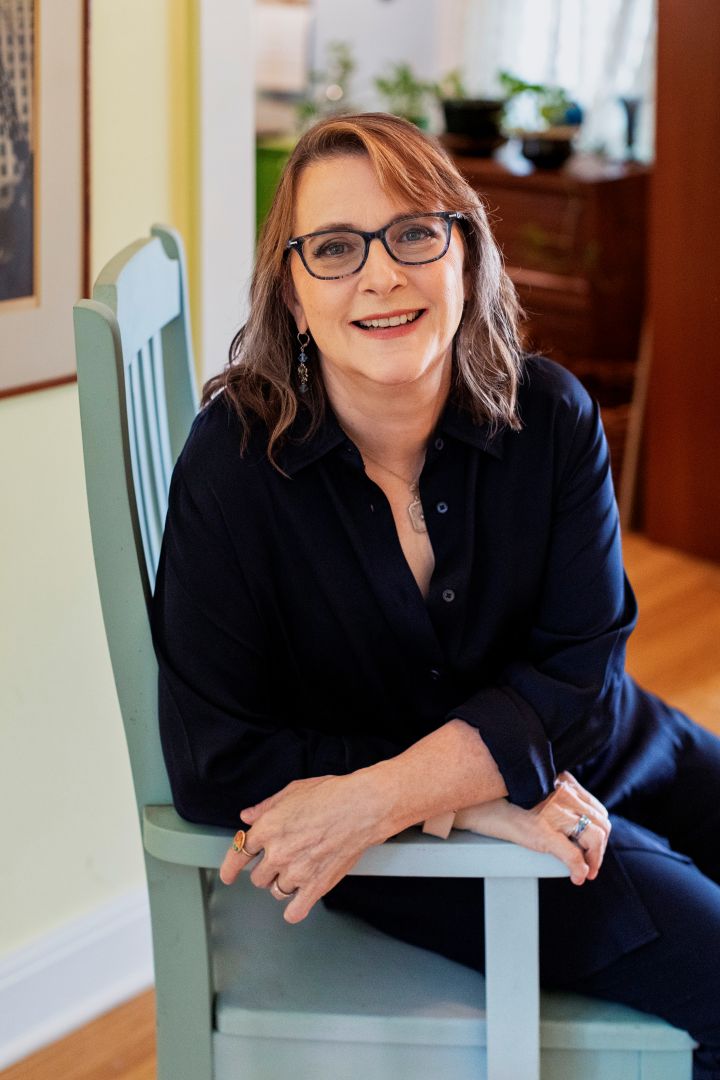
Miriam Kuznets’ novel, The Gray New Deal, will be published by Flexible Press in 2026. Her fiction and non-fiction have appeared in Narrative, Austin Noir, The Southern Review, The Antioch Review, and other publications. She earned an MFA from the Iowa Writers’ Workshop and top fiction awards from Barnard College and the Poets and Writers Exchange. She lives in Austin with her husband and has been a licensed psychotherapist since 1995.