
Editor’s Note: Sarah Ruhl (born January 24, 1974) is an American playwright, professor, and essayist. Among her most popular plays are Eurydice (2003), The Clean House (2004), and In the Next Room (or the Vibrator Play) (2009). She has been the recipient of a MacArthur Fellowship and the PEN/Laura Pels International Foundation for Theater Award for a distinguished American playwright in mid-career. Two of her plays have been finalists for the Pulitzer Prize for Drama and she received a nomination for Tony Award for Best Play. In 2020, she adapted her play Eurydice into the libretto for Matthew Aucoin‘s opera of the same name. Source: Wikipedia
*****
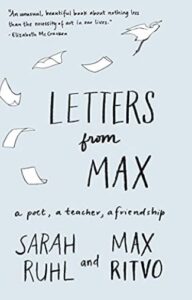 Last summer, I read the hundred essays she didn’t have time to write. They became the hundred essays I didn’t have time to read, which is to say, they became the hundred essays I had precisely enough time to read. They were small gifts to mothers of young children. I am a mother of young children. They were delightful and insightful, though for whatever reason, I didn’t read more Ruhl until this summer, when the letters to and from Max Ritvo surfaced on my stack. I was scared of them because I knew Max’s story. I knew he was brilliant and young and cancer ravaged him and he was gone. But I started reading and found myself immersed in a book of bodhisattvas corresponding in the center of suffering. My spirit was lifted by those letters. Ritvo and Ruhl. Ruhl and Ritvo. I sat at pool-side and read and read, while my kids did cannonballs, and felt that, despite all the covid, the cancer, the heat waves, it was going to be all right. There had always been and would continue to be refuge in a life lived close to the words. There was and would be refuge in friendship and letters and in writers like Ruhl.
After the letters came everything else: the courageous memoir of her face, the poems, the many plays. Ruhl writes every genre. She translates Chekhov. She adapts Woolf. She re-works Bishop and Lowell’s correspondence. She brings Tibetan Buddhist monks on stage. She has a play about a Victorian vibrator. She uses the stage, the players, the words—and the silences between them— to say something about our joy and our suffering. Once, many years ago, I fell deeply in love with a person whose heart was with the theater. I read all the plays with him. The moderns and ancients. Even the medieval mysteries. He pointed me to Euripides, Sophocles, Marlow, Ibsen, Shaw, Wilde, Pirandello, Beckett, Pinter, Albee, Stoppard, Kane, Vogel, Reza. And did I mention Shakespeare? All of Shakespeare? And Chekhov, my god, Chekhov. And I loved this person and I loved the theater and it became hard to separate them, the person and the theater, so big was my love for both of them. Because really, the theater is love. Ruhl is at home in the theater, so reading her this summer brought me back to that world inside me; brought me back to that love. That’s part of how she saved me. One senses Sarah Ruhl could write a play about any of our lives, with its pathos and beauty and humor. She could write a play about my life: a non-confrontational mother of a strong-willed daughter who furiously creates cartoon drawings and thinks children should be in charge of the world. And did I mention, Ruhl also writes lyric poetry? I read her poems too, and they made me think of Menashe and Cavalli and the beloved Issa. Her Love Poems from Quarantine confirm the truth of writing, “I stand before you in a great deal of uncertainty, writing what comes, as a practice.” She writes what comes and so I read, willingly what she gives, in the face of my own uncertainty, as a practice.
What I want to say is that Ruhl’s soul (yes, her soul) seems lovely seems compassionate seems funny seems kind. And that with each text I read, my heart, yes, my heart, is opened, is softened, is warmed. When I read Ruhl, I widen. I’m hugged, I laugh, I tear up, I sigh. I sense it is going to be all right. She is a master of the poetics of care. And I’m not yet done with her. I haven’t read her Eurydice or the Peter Pan play, though I just finished The Clean House. Funny, because after two years of therapy, what finally seems to be helping my marriage is Olga, from Portugal, coming every two weeks to clean our house. I haven’t yet seen one of Ruhl’s plays on the stage. I can’t wait for that. And I’m sure a new book will be coming soon. Because she just keeps writing. She writes every genre, though she seems most at home with the drama. Perhaps this is because the play is the thing that ultimately reminds us, we are to the gods as flies are to wanton boys. The play reminds us that our lives are play. And that we should play despite the horror and uncertainty and the rest beyond our control.
I thought to write this little essay as a letter to Sarah, but maybe that seems presumptuous. She is the “mother-writer” I’ve been looking for. These days, I’ve been working on explaining, in my professional life, that I’m a mother. I am working on advocating for that particular identity as a particular strength. I want to thank Ruhl for this. She makes this work real for me. Thank you, Sarah Ruhl, for being such a good mother. Thank you for writing every genre, for making writing a practice. Thank you for, with your work, taking care of me.
Anyway, sometime in early July, I read the letters between Sarah and Max, while watching my kids swim in a pool next door to a house where the young mother had just died a terrible death of a terrible cancer. I could feel the emptiness of that house, the grief exhaling from its closed windows, while my kids cannonballed and belly-flopped with their twisted goggles and tangled hair. My kids, who, for the time being, do not know much of things like school shootings and cancer and climate change. I hold all this in my heart and take refuge in the words of writers like Ruhl.
Thank you Sarah, for those letters to Max. No other book gave me so much courage to care.
*****
Jesse Curran is a poet, essayist, scholar, and teacher who lives in Northport, NY. Her essays and poems have appeared in a number of literary journals including About Place, Spillway, Leaping Clear, Ruminate, The Whale Road Review, Blueline, and Still Point Arts Quarterly. www.jesseleecurran.com