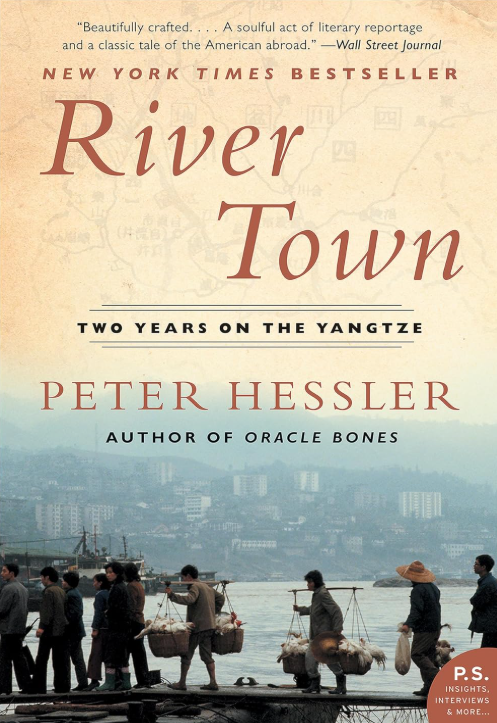
The way I tend to write is less about beginning with a clear argument and more about paying attention to small moments until they begin to suggest something larger. I am drawn to writers like Peter Hessler and Lauren Winner because they are able to do this so well. In “River Town” and “Still: Notes on a Mid-Faith Crisis”, the authors spend time noticing the texture of daily life (conversations, routines, quiet observations) and somehow those details accumulate into a deeper understanding of place, identity, and belief. That is the kind of writing that feels most natural to me.
I return often to my own memories, especially from growing up in Hungary in the 1980s, and then later returning there as a teacher in the 2000s. There is something about that setting, distant and familiar, that lends itself to reflection. I think of small, concrete moments: a classroom, a street corner, a conversation that didn’t seem important at the time. Those are the moments that tend to stay with me, and they are usually where writing begins. The same has been true in China, and now in Japan, where I am constantly aware that daily life is layered with meaning that is not always immediately obvious.
My process often starts in a fairly unstructured way. I will sit down and write in a kind of stream of consciousness, not entirely sure where I am going. These early drafts are usually rough, sometimes scattered, but they feel necessary. They allow me to capture something honest before I have the chance to overthink it. In those moments, I am not trying to prove anything or even to make sense of anything. I am simply trying to see what is there.
Only afterward do I begin shaping what I have written into something more deliberate. This is where clarity and structure begin to emerge. I look for patterns, for connections, for the underlying idea that might be holding the piece together. Often, what began as a simple observation turns out to carry more weight than I initially realized. The work then becomes one of refining that insight without losing the immediacy of the original moment.
In the end, I think I write in order to better understand the relationship between the ordinary and the meaningful. The Haiku poetry I am currently reading in Japan gives a good perspective on this: small, seemingly insignificant moments of daily life…that nonetheless contain more meaning than I would have originally imagined.
*****