
The afternoon I was supposed to sign my employment contract, I walked out the company doors, resolved never to return.
It was the day after my graduation party, and Mom blamed it on the hangover. Dad said it didn’t seem like something I’d do, but that he wasn’t surprised. That hurt. My quirky friends cheered and tossed me in the air. My straight-laced friends looked at me sideways and asked why — none of them seemed convinced. The truth is, I made up a different excuse for each one.
I could’ve blocked the office and staff numbers, but that felt too harsh — there was no anger in my departure. For days, the calls and messages came through. I could never bring myself to answer or reply. Every time the buzzing of my phone confronted me, I questioned what was wrong with me, how cruel I truly was.
One of those times, as I stared blankly at the ringing screen, a well-dressed man sitting at the other end of the park bench remarked that he wasn’t much of a talker either.
I was at the park where I used to rest between college classes and my shifts as an intern. It wasn’t exactly close to the office — about a thirty-minute walk. Even after I quit, I kept going there. I liked the shade of the grass, stretching smooth and even across soccer fields bordered by ipê trees. The green was vivid, simultaneously flat and plush, as if the grass were artificial or brought in from distant, romantic places — British or Danish meadows. Around the fields, mostly empty in the early afternoon, wound a circular asphalt path where mothers with toddlers, elderly men with dogs, and solitary young people strolled.
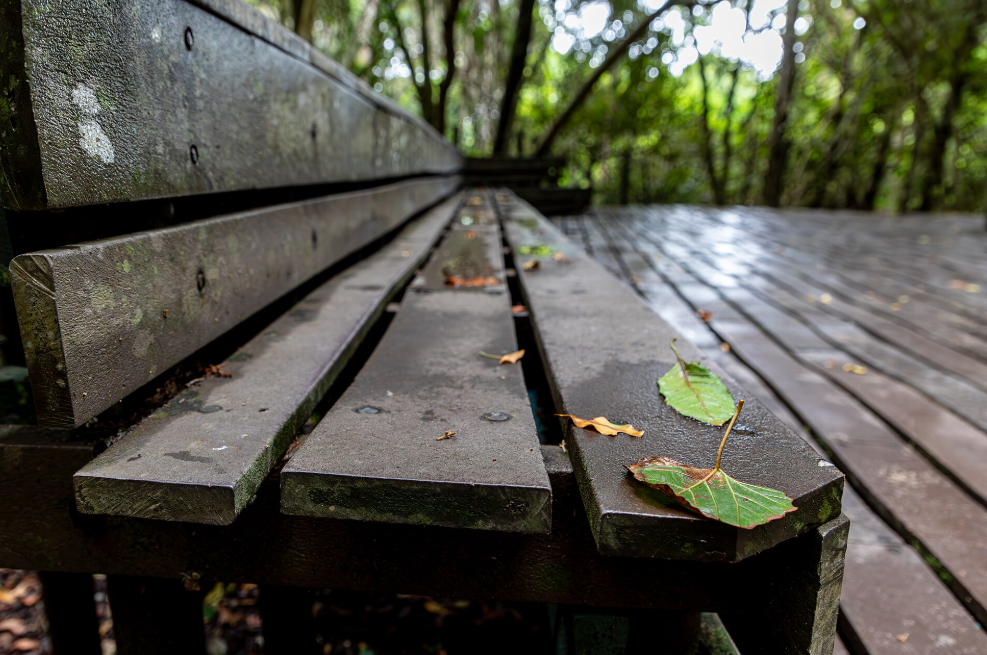
When I was working, I’d sit on one of the benches lining the park and simply breathe in the landscape. After I left the office, I sat on the benches to draw. Usually, I sketched impossible structures — buildings interlocked like puzzle pieces, their walls merging and splitting at random; towers twisted like vines, unfurling butterfly-like wings from their upper halves; bridges looped endlessly into themselves, suspended in midair. But sometimes, if something struck me, I’d draw portraits of passersby, their expressions half-hidden in sunlight, or a heron tracing long arcs above an ipê, or a cloud stretched thin, like pulled cotton.
If I really liked a drawing, I’d wait for a child to appear and give them the sheet. If I liked it just a little, I’d leave the paper on the bench, held down with a pebble to keep it from flying away. If I didn’t like it at all, I’d wait for a quiet moment and burn it with a lighter.
Spending my days sketching in pencil wasn’t what I’d envisioned for myself when I walked out the company doors, resolved never to return. What had I envisioned? That was the question I kept asking myself, after the euphoria of the first few days of freedom wore off. I was stuck with the boredom of having no obligations, and invitations from friends seemed meaningless. An anxiety about the future began to creep in.
By then, I was already meeting every day with the well-dressed man who’d commented that he wasn’t much of a talker. Or rather, he was the one who came to meet me at the park. And, in truth, he was a talker, very much so — a relentless questioner. His insistence on asking personal questions was strange: You draw well — do you do that professionally? Are you on vacation? Do you plan to stay here or try your luck in another city, maybe abroad? Do your parents nag you or support you? Do you think about getting married, having kids? How do you feel the passage of time?
It wasn’t just strange. It was obsessive. Still, I answered. I enjoyed reflecting on what was happening in my life based on the questions he posed, on the way he framed things. The moments when Henrique — that was his name — shared the park bench with me, maybe fifteen minutes a day, brief as that, became the best part of my afternoons.
He never seemed in a hurry, but when he left, it was abrupt, as if he shouldn’t have been there at all. He wore work clothes. Nothing too fancy — creased slacks and a collared shirt, the sort of attire an engineer or journalist might wear. He never looked at me as we talked, but he stole glances when I was distracted. Complimenting my drawings with detailed observations was his favorite way to soften me up for the next interrogation. Compliments — only for the drawings.
He never showed any interest in me, the flesh-and-blood me. It could’ve been shyness, but he was so assertive. It could’ve been disinterest in women, but I noticed how he got flustered when certain girls wandered through the park. It could’ve been respect and patience, but someone so discreet wouldn’t have sat next to me in the first place. Or maybe it was just rejection, and that would’ve been hard.
I didn’t make a move, didn’t suggest anything. Sometimes I’d watch him from the corner of my eye, sensing that something weighed on him. At rest, his eyebrows knit together in a face that looked stern or meditative. One afternoon, I broke the pattern and asked if something at his job was bothering him. Henrique replied that he wasn’t surprised I thought work was the root of all human problems. I tried to argue, saying that I increasingly felt like difficulties came from an unreachable place, but he didn’t want to talk. He jumped up and left, leaving me alone with my sketches and my regret.
The next day was a Saturday, and I wasn’t expecting him, but he showed up, in shorts, a tank top, and high spirits. A different Henrique, a weekend Henrique. I stayed quiet, touching up a drawing of a circular bridge covered in trees, connecting a beach to a rocky island. He twirled a car key on his finger, waiting. When I was done, he asked me to take a ride. I burned the drawing and went with him.
Somehow I expected a long drive, maybe to a restaurant at the foot of the mountains, maybe to a lookout point. But he drove only a few blocks and pulled into the garage of a building I recognized with a chill — it was where my old architecture firm was located. Henrique told me to stay calm. As soon as he parked, I wanted to run — through the lobby, out to the street — but a dark curiosity pinned me in place.
We went up to the administrative office, and Henrique unlocked a small room marked Accounting. From a drawer, he pulled out an envelope and handed it to me. Inside was a check. For your last month as an intern, he explained. That was no real explanation, and he knew it.
I’ve worked here for years, he continued, and not a day has gone by that I haven’t thought of leaving and never coming back. Not here, not to any other company. You don’t remember me, but I remember you. In the elevator, in the cafeteria, picking up your monthly checks with Ruth, right here next door. I saw you at the park by chance. I would’ve introduced myself, but you never showed interest, so I followed your lead. I wanted to know how it felt…how it felt to be someone who’d given up everything, who just wanted to exist within time, free, unoccupied, immense. I realized you’re not happy, and now I have no doubts.
I turned around, took the elevator, and walked back out the door I thought I’d closed forever. I hated him. I felt used. And I knew I’d been defeated.
The next day, I sent my résumé to a dozen architecture firms. Today, I have my first interview, and life feels like an unfinished, amateurish, nonsensical drawing. I could very well burn this drawing, but for now, I’m putting a pebble on it, so the anguish doesn’t carry it away.
*****
Ricardo Bernhard is a Brazilian writer and diplomat currently based in South Africa. His novels portray Brazil’s middle class as they grapple with exile (chosen or imposed), buried histories, and the limits of what understanding can repair. While his novels have not yet been translated into English, he hopes his short stories will serve as an introduction to his voice for a broader audience.